


Marketing automation for universities and colleges
Every course, open day and application deadline needs posts, and your team is small for the number of programmes you run. Maggie, your AI CMO, writes course guides, open day posts and student stories around the admissions year, and your team approves every one.
Free to start · No credit card · 30 free posts
Used by 600+ users and trusted by teams at
aeglesriphal.com
moonlakespa.com
shop.theteagroup.com
clo100.com
logtrics.io
mymorez.com
nextidal.com
otisapp.com
storaitelling.com
theheatpumps.co.uk
web-translations.com
exposeai.tech
orielipo.com
whitelabelcrowd.fund
elliptic.co
med.moonlakespa.com
netdex.co.il
orawellness.uk
reenest.com
syngage.ai
thepenthouseliving.com
zengolf.studio
imaintain.uk
rebuildingsociety.com
aurasocial.world
goaimex.com
moneyparents.com
newgenrenewables.uk
osmosisai.co
saunders.ac
teeza.app
thursdayclub.com
Why universities and colleges struggle to keep their marketing going
The admissions year never stops. As soon as one intake starts, the next round of open days, applications and enquiries is already on its way.
Dozens of courses, one small team
Every department wants its open day promoted and its courses written up. The marketing team can cover the big undergraduate subjects, and the smaller courses, part-time routes and short courses go quiet.
Deadlines don't move
Open days, application deadlines, results day, Clearing and January starts all arrive on fixed dates. Posts that go out a week late reach people who have already chosen somewhere else.
Prospective students ask search and AI first
A sixth former asks “what can I do with a psychology degree” and a career changer asks about part-time nursing courses near them. If your pages don't answer plainly, another institution's do, or an AI answer leaves you out.
Every word has to be right
Entry requirements, fees, accreditation and graduate outcomes have to be accurate and fair. Writing quickly and checking carefully pull in opposite directions when the team is stretched.

The autumn open day is three weeks away, and every faculty has its posts.
It's Monday in late September. The autumn open day is three weeks out, the business school has a new part-time MBA starting in January, and the engineering department wants its new workshops shown off. Your team of three is still answering enquiries from the new intake.
You paste the college's website into cmo.so. Maggie reads it and writes your brand profile: a college with undergraduate, foundation and part-time courses, strong links with local employers, the students who come from the region and from abroad, your campus and the friendly, clear way you speak to applicants. You correct one thing: the fashion foundation year has closed to new students. You switch on Content Policy Guard with education rules and add your own: never promise jobs or graduate salaries.
By Tuesday the drafts are waiting, each with a picture in your college's look: a blog post on what to ask at an open day, an Instagram post about the new engineering workshops, a LinkedIn post about the part-time MBA for working managers, and a Google Business post for the open day with a button to the booking page. Content Policy Guard has held one line that said the MBA would “guarantee promotion” and suggested a fairer rewrite. The head of the business school checks the course details, and you approve the rest from your phone.
The posts go out at the times you set for each channel and each comes back with its link. While you're preparing the open day talks, Maggie is already planning posts for the application deadline, and Search Console in cmo.so shows which course guides applicants are finding.
A marketing assistant who knows the admissions year
Each of those problems has an answer, and your team still decides what goes out under your institution's name.
Course guides for every programme
Posts on what a course covers, who it suits, where it can lead and what student life is like, for the big subjects and the small ones, written for Google and for AI answers. Published to your WordPress, Webflow or Wix site, or any site through the cmo.so API.
Blog on autopilotPlanned around the admissions calendar
Open days, application deadlines, results day, Clearing, January starts and postgraduate intakes. Posts are written and queued weeks ahead so they reach applicants while they're still deciding.
Seasonal scheduleEvery audience, in its own channel
Instagram, TikTok and YouTube for school leavers (in beta), LinkedIn for postgraduates, employers and research partners, and Google Business for open days and campus events.
Every channelChecked against education rules
Turn on Content Policy Guard with education rules or your own. A post that may break them is held as a draft with a suggested rewrite. These are AI suggestions, not legal or compliance advice, so keep a person reviewing posts.
Content Policy GuardYour institution's voice
Enter your website and Maggie builds your brand profile: your courses, your students, your campus, what sets you apart, competitors and voice. Every post and picture starts from it.
Brand profileFaculty reviewers, central sign-off
By default nothing goes out until it's approved. Add colleagues in Me → Team with presets such as editor or manager, so a course leader can check details before the marketing team approves.
ApprovalsYour marketing team, in your pocket
Real screens from the cmo.so app on iPhone.
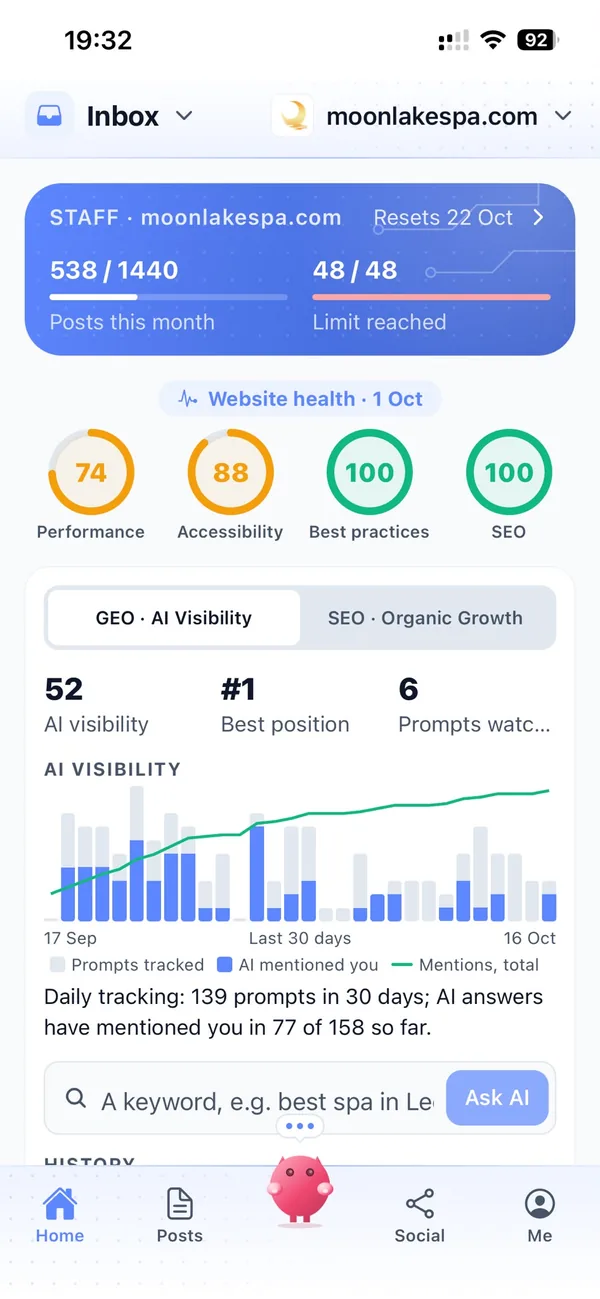
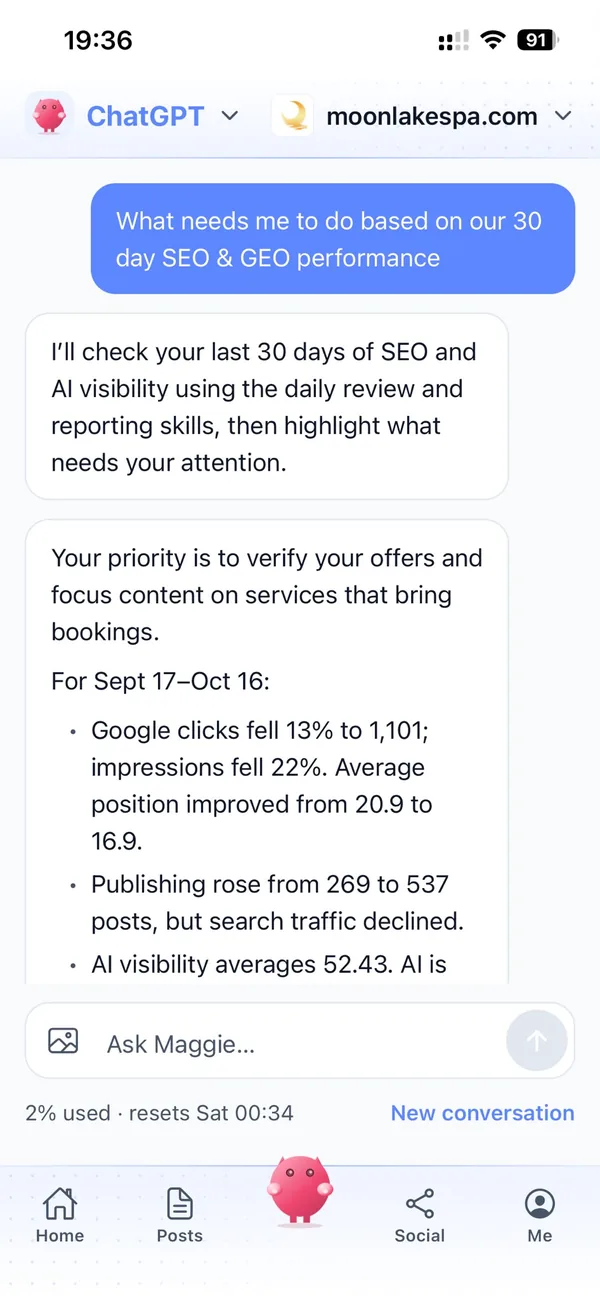
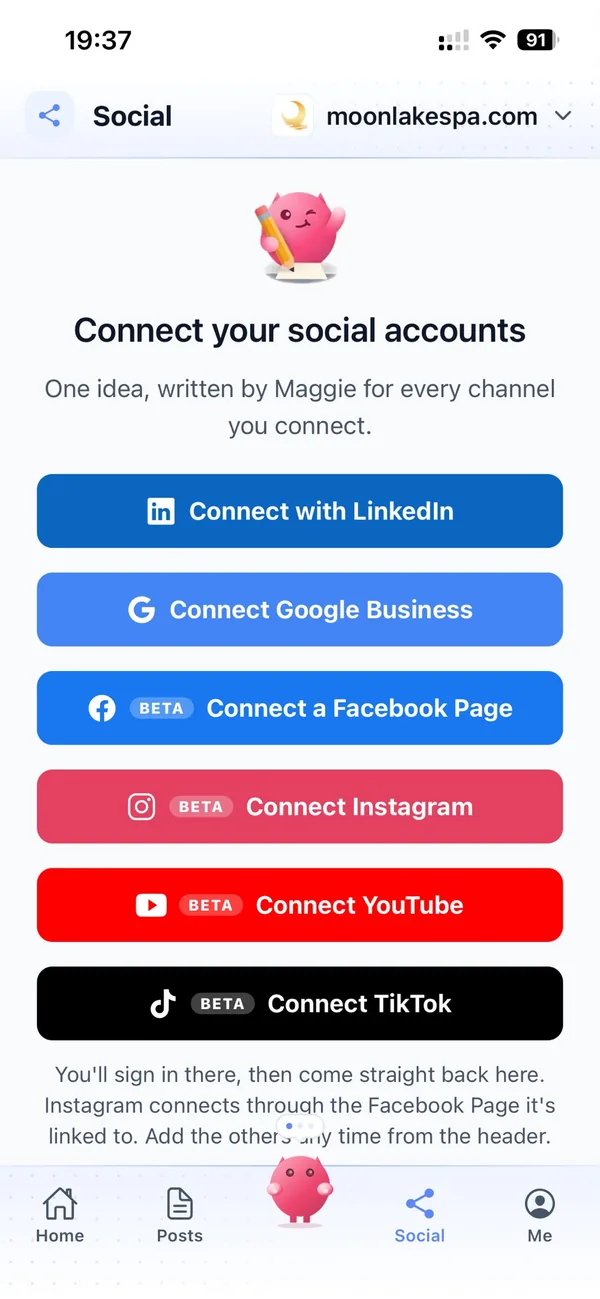
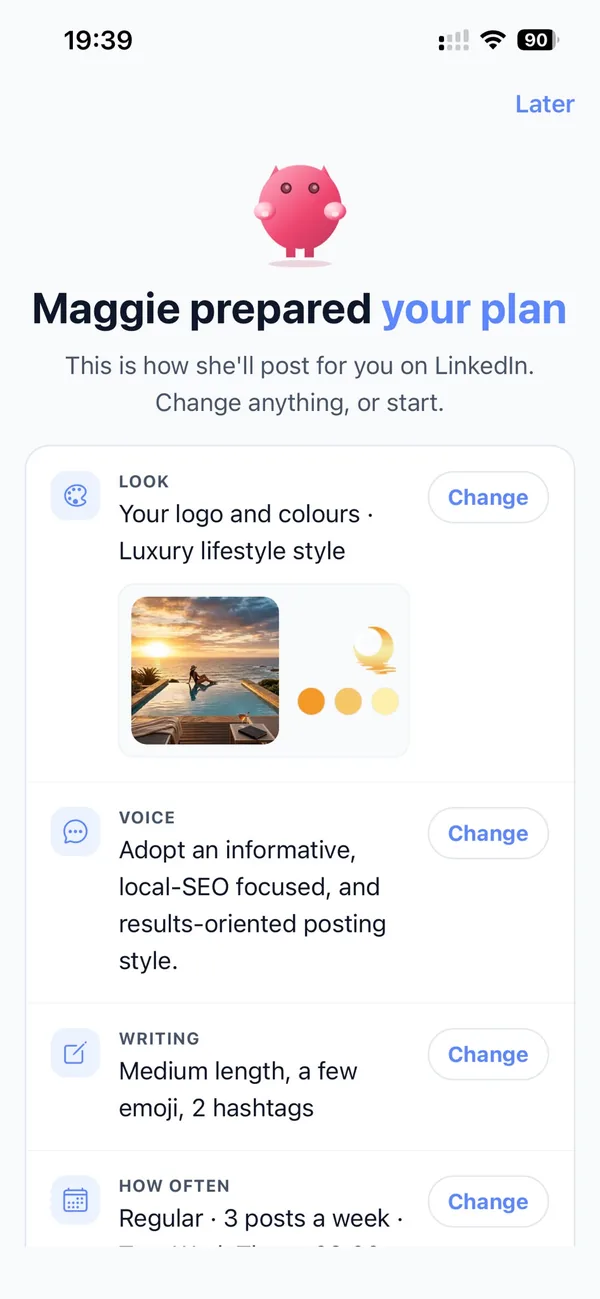
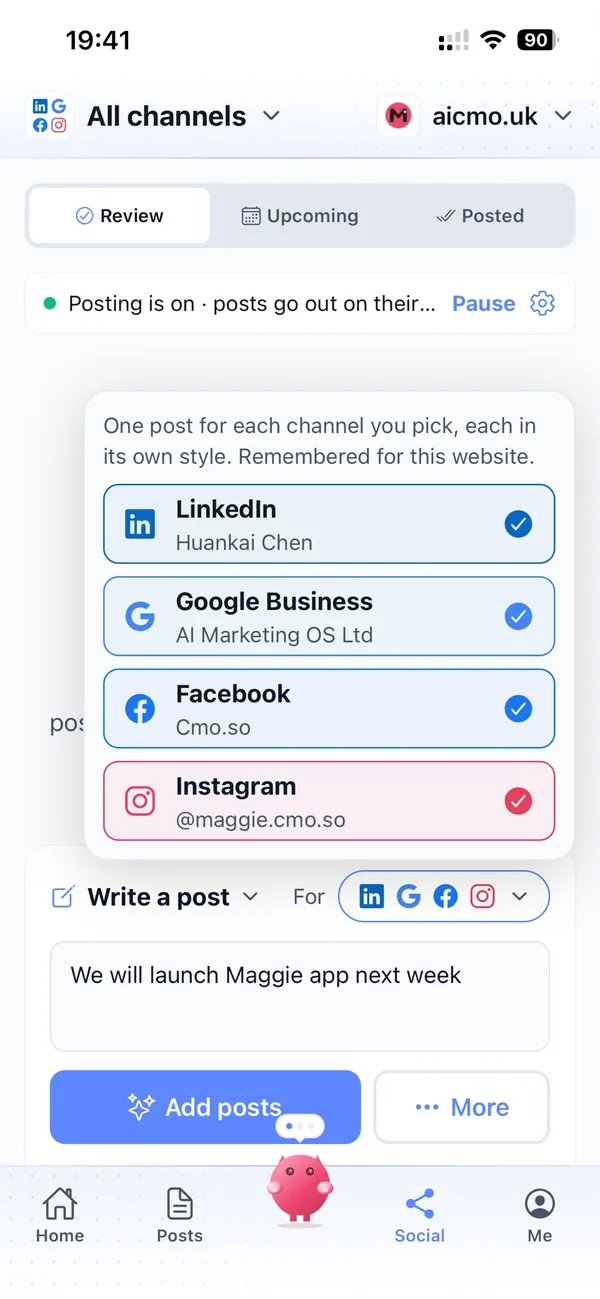
From your website to a full admissions calendar of posts in four steps
Enter your website
Maggie reads it and drafts your institution's brand profile in minutes.
Set your rules
Correct the profile, add your key dates and switch on Content Policy Guard with education rules or your own.
Review the drafts
Your first week of posts arrives with pictures. Course teams check details; you approve, edit or skip each one.
Let them go out
Approved posts go out at each channel's times and every one comes back with its link.
Why not just…
The usual ways universities and colleges try to keep up, and where each one runs out.
…hire another content officer?
A full-time marketing hire in the UK costs around £3,000 a month before tools, and one more person still can't write weekly posts for every course and channel. Maggie drafts them, and your team reviews.
…brief an agency for each campaign?
SEO and content agencies often cost around £1,000 a month, and each campaign needs its own brief and approval round. Maggie writes and publishes every week from £15 a month per website.
…ask student ambassadors to post?
Ambassadors bring real voices, but they have exams, placements and summers away. Their posts work best alongside a steady schedule, and Maggie keeps that schedule going all year.
…write it with ChatGPT?
You still brief it, check it, make the picture and post it yourself, and it doesn't know your courses, your dates or your rules. Maggie remembers your institution and holds a risky line for review.
Cut the £5,900/mo marketing bill to £15/mo
Everything a marketing team does, done by Maggie.
| What needs doing | Without cmo.so | With cmo.so |
|---|---|---|
| Full-time marketing hire | £3,000/mo | Included |
| SEO and AI search (GEO) agency | £1,000/mo | Included |
| Content writer, AI-assisted | £500/mo | Included |
| Social media manager, freelance | £800/mo | Included |
| Designed pictures for every post | £300/mo | Included |
| SEO and GEO softwareRank tracking, site audits, AI visibility | £250/mo | Included |
| AI writing and image tools | £50/mo | Included |
| Working hours | Office hours | 24/7 |
| Total per month | £5,900+ | From £15/mo |
Typical UK costs for a small business in 2026, with AI already cutting freelance rates. Estimates only; your own quotes will vary.
- 5 social posts, 30 once verified
- 15 Maggie messages a day
- Upgrade any time
- 12 posts a day
- 150 Maggie messages a day
- All channels
- 96 posts a day
- 1,000 Maggie messages a day
- All channels
Per website, billed monthly. Blog and social posts share one allowance; your best plan sets how much you can talk to Maggie across all your websites.
Marketing automation for universities and colleges: your questions
Still unsure?
What is marketing automation for universities and colleges?
It's software that does the repeating work of marketing a university or college: planning posts around the admissions calendar, writing course guides, open day and student story posts, making pictures and publishing on schedule.
With cmo.so, Maggie does all of it from your website, and nothing goes out until someone on your team approves it.
How do universities and colleges get more students online?
Universities and colleges get more students online by answering the questions applicants search for, course by course, and by being visible at the moments they decide: before open days, application deadlines and results day.
Maggie writes those posts every week and queues them around your key dates, and Search Console in cmo.so shows which course guides bring applicants to your site.
How much does marketing automation cost for a university or college?
There's a free plan with no card needed. Paid plans are per website and billed monthly: Pro at £45 a month suits an institution posting on several channels, Max is £75 a month, and Elite at £195 a month covers up to 96 posts a day for many brands or websites.
Air at £15 a month suits a single department or a small college. Founding members get lower prices for good on every plan until 1 January 2027, and you can cancel any time.
Which channels should universities and colleges start with?
Most institutions start with their own website for course guides, plus the channel their applicants use most: Instagram, TikTok and YouTube for school leavers (all in beta), and LinkedIn for postgraduates, adult learners and employers.
Google Business helps people find your campus and open day events. Each channel has its own posting times and queue.
Is it safe to use AI to write university marketing?
It is safe when a person reviews every post before it is published. cmo.so keeps approvals on by default, and Content Policy Guard can check posts against education rules or your own, holding a post that may break them as a draft with a suggested rewrite.
These are AI suggestions, not legal or compliance advice. A qualified person should still review posts, and your institution stays responsible for what it publishes.
Can it keep entry requirements and fees accurate?
It works from your website and brand profile, so posts are only as current as those pages. When requirements or fees change, update the profile, and Maggie uses the new details from then on.
Ask course teams to check any post that mentions requirements, fees or accreditation before it is approved.
Can each faculty or campus have its own posts?
It can. If each faculty, school or campus has its own website, add them all to one account and each gets its own brand profile, channels, schedule and approvals.
If they share one website, Maggie can plan posts for each department from the same brand profile, and you can give course leaders a reviewing role in Me → Team.
Can it help with Clearing and late applications?
It can have posts ready before results day. Tell Maggie which courses may have places and she drafts posts for your blog and channels, so you can approve them as soon as you know what's available.
You can pause a channel or skip a post the moment a course fills up.
Can it write student and graduate stories?
It can, from what you share with it. Give Maggie a few lines from a student or graduate, with their permission, and she writes a story for your blog and a shorter post for social channels.
Stories should never need invented quotes or outcomes, and you review every draft before it goes out.
Does it connect to our student record or application systems?
No, cmo.so doesn't connect to student records, admissions systems or enquiry inboxes. Maggie works from your public website, your brand profile and what you tell her.
Applications and enquiries still go through your own systems, and cmo.so never sees student data.
Which websites does it work with?
cmo.so publishes to WordPress, Shopify, Wix and Webflow, and to any other website through the cmo.so API.
Each post is reported back with its link once it is live.
Have every open day's posts ready before the invitations go out
Enter your website. Your brand profile and first week of posts are ready in minutes, and nothing goes out until your team approves it.
- Free plan, no card needed
- You approve every post
- Cancel any time