


Marketing automation for research organisations
Your work only has impact when funders, partners, policymakers and the public hear about it. Maggie, your AI CMO, turns new papers, projects and events into clear posts for your website, LinkedIn and Google Business, and your team approves every one.
Free to start · No credit card · 30 free posts
Used by 600+ users and trusted by teams at
aeglesriphal.com
moonlakespa.com
shop.theteagroup.com
clo100.com
logtrics.io
mymorez.com
nextidal.com
otisapp.com
storaitelling.com
theheatpumps.co.uk
web-translations.com
exposeai.tech
orielipo.com
whitelabelcrowd.fund
elliptic.co
med.moonlakespa.com
netdex.co.il
orawellness.uk
reenest.com
syngage.ai
thepenthouseliving.com
zengolf.studio
imaintain.uk
rebuildingsociety.com
aurasocial.world
goaimex.com
moneyparents.com
newgenrenewables.uk
osmosisai.co
saunders.ac
teeza.app
thursdayclub.com
Why research organisations struggle to keep their communications going
Researchers are busy with the research. The comms team, if there is one, is a person or two covering every project, every event and every funder update.
Papers published, then silence
A paper that took three years comes out, gets a line on the publications page and a single post. The people who could use it, cite it or fund the next stage never hear about it.
Written for reviewers, not readers
Abstracts are written for peer reviewers. Funders, journalists, industry partners and the public need the same finding explained in a few plain sentences, and nobody has time to write them.
Events that need an audience
Seminars, public lectures, open days and webinars all need promoting weeks ahead, on top of the work of organising them. Too often the invitation goes out a few days before.
Impact is hard to show
Funders and partners want to see your work reaching people. A news page last updated two terms ago and a quiet LinkedIn page make that harder to show.

The paper came out on Monday. By Friday, people outside your field know what it found.
It's Monday, and the institute's new paper on urban air quality is finally out. There's a public lecture about it in three weeks, a funder wants an update and the comms inbox is already full.
You enter the institute's website into cmo.so. Maggie reads it and writes your brand profile: your research themes, your current projects, the funders, partners and policymakers you want to reach, how your work differs from other groups in the field, and the careful, plain-spoken way you explain science. You correct one thing: the transport project finished last year, and the team has moved on to housing.
By Tuesday the drafts are waiting, each with a picture in the institute's look: a blog post explaining the paper's main finding in plain English with a link to the full text, a LinkedIn post from the lead researcher's point of view, a post inviting local residents to the public lecture and a Google Business event with a button to book a seat. The lead researcher tightens one sentence about what the study can and can't show, and you approve the rest.
The posts go out at the times you set for each channel, and each comes back with its link. While the team gets back to the next study, Maggie is already planning a series on the housing project, and Search Console in cmo.so shows which explainers people are finding.
A communications assistant who reads the research
Each of those problems has an answer, and your researchers still decide what goes out in the organisation's name.
Plain-English research summaries
Blog posts that explain what a study looked at, what it found and why it matters, linking to the full paper. Written for Google and for AI answers, and published to your WordPress, Wix, Webflow or other website through the cmo.so API.
Blog on autopilotLinkedIn for funders and partners
Posts on new projects, partnerships and findings in a voice that suits funders, industry partners and policymakers, so the people who back your work see it moving.
LinkedInSeminars and lectures that fill up
Invitation posts planned weeks ahead of seminars, open days and public lectures, plus Google Business events with a Book button for people searching nearby.
EventsOne profile, many projects
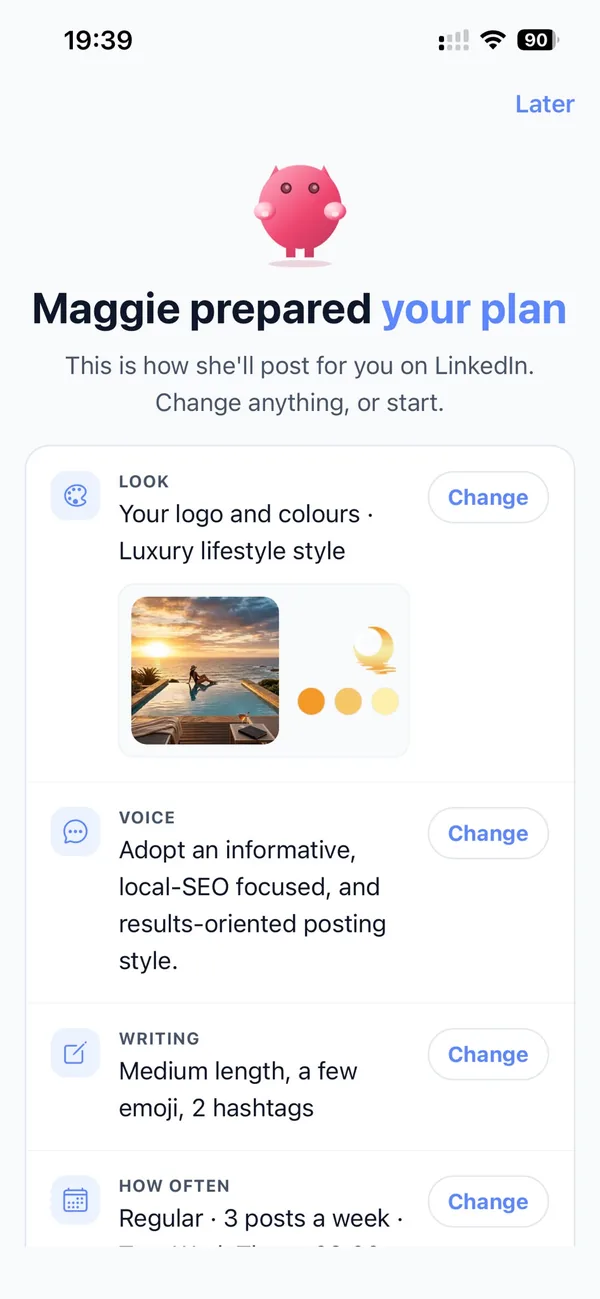
Your brand profile holds your research themes, current projects and the audiences you want to reach. Every post starts from it, so the voice stays the same across teams.
Brand profileResearchers check before it goes out
By default nothing is published until it's approved. Add researchers in Me → Team so the person who did the work checks every claim about it.
ApprovalsSee how AI answers describe you
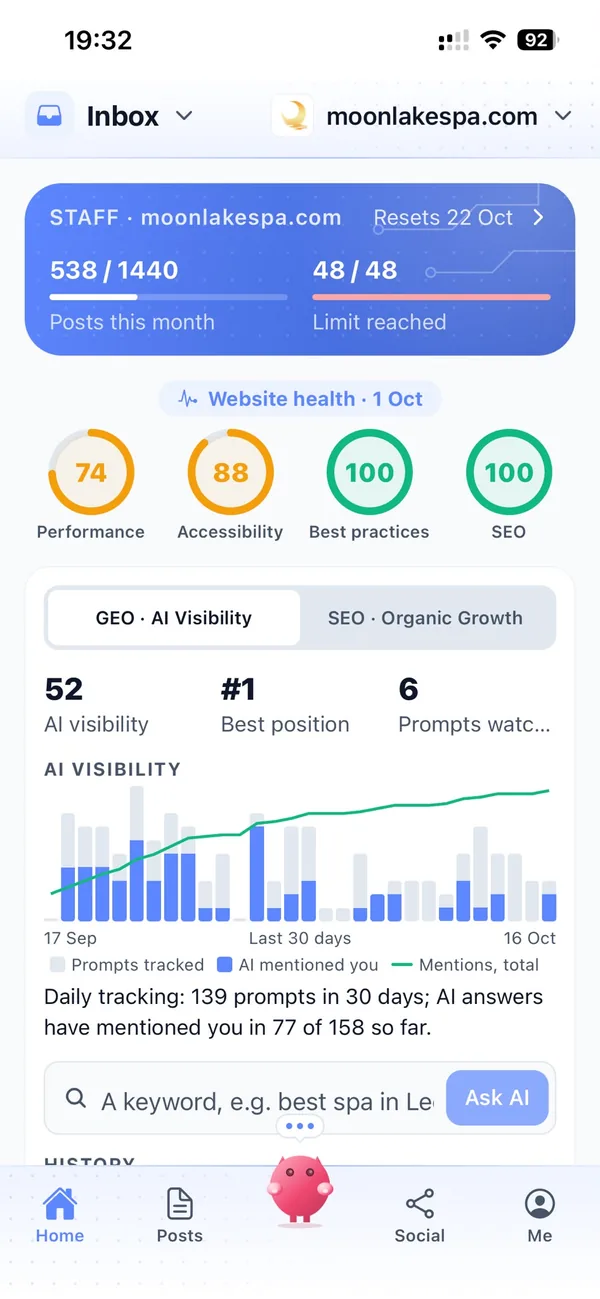
AI visibility shows how Google's AI answers describe your organisation and its work, and Search Console shows which posts bring readers to your website.
AI visibilityYour marketing team, in your pocket
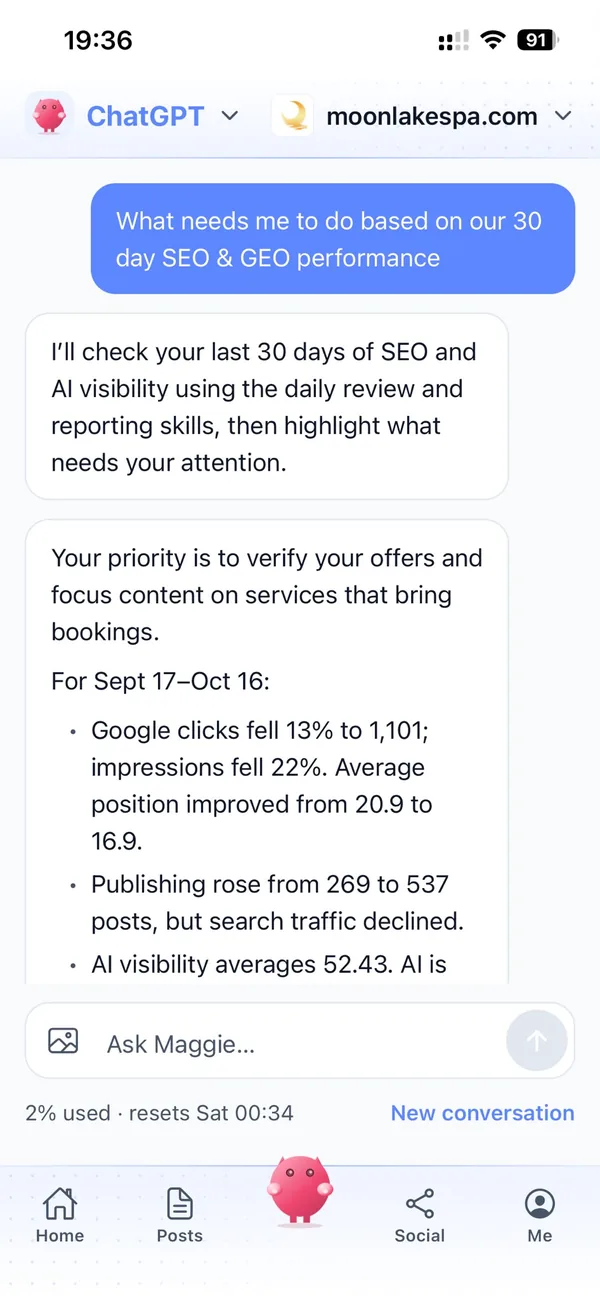
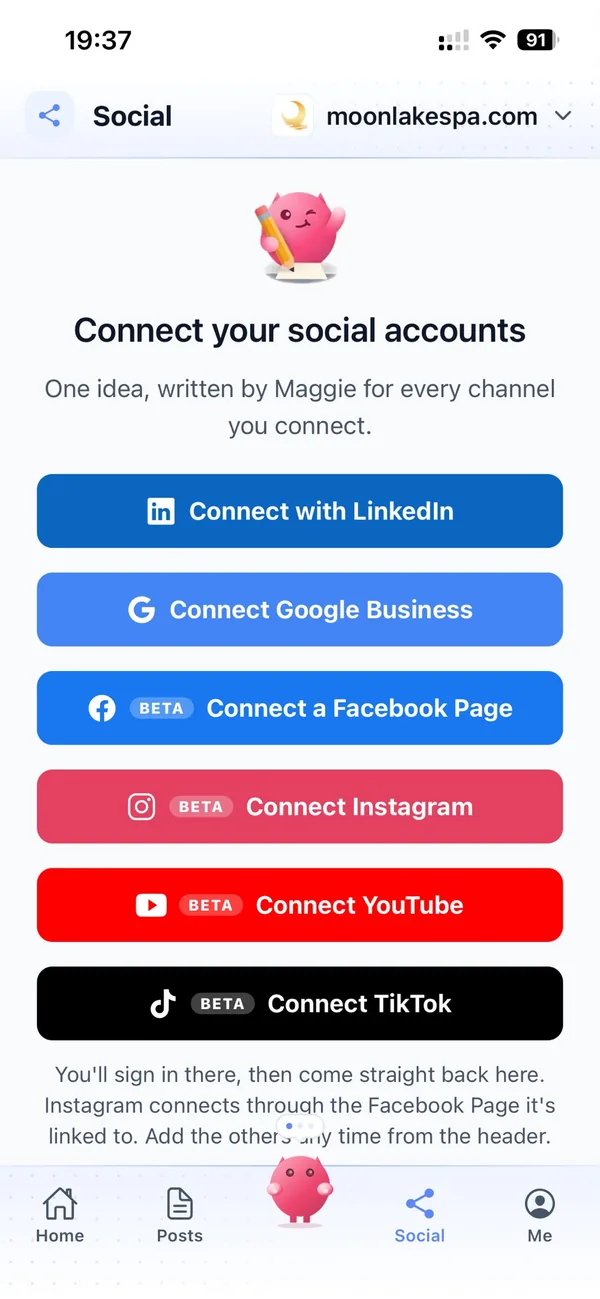
Real screens from the cmo.so app on iPhone.
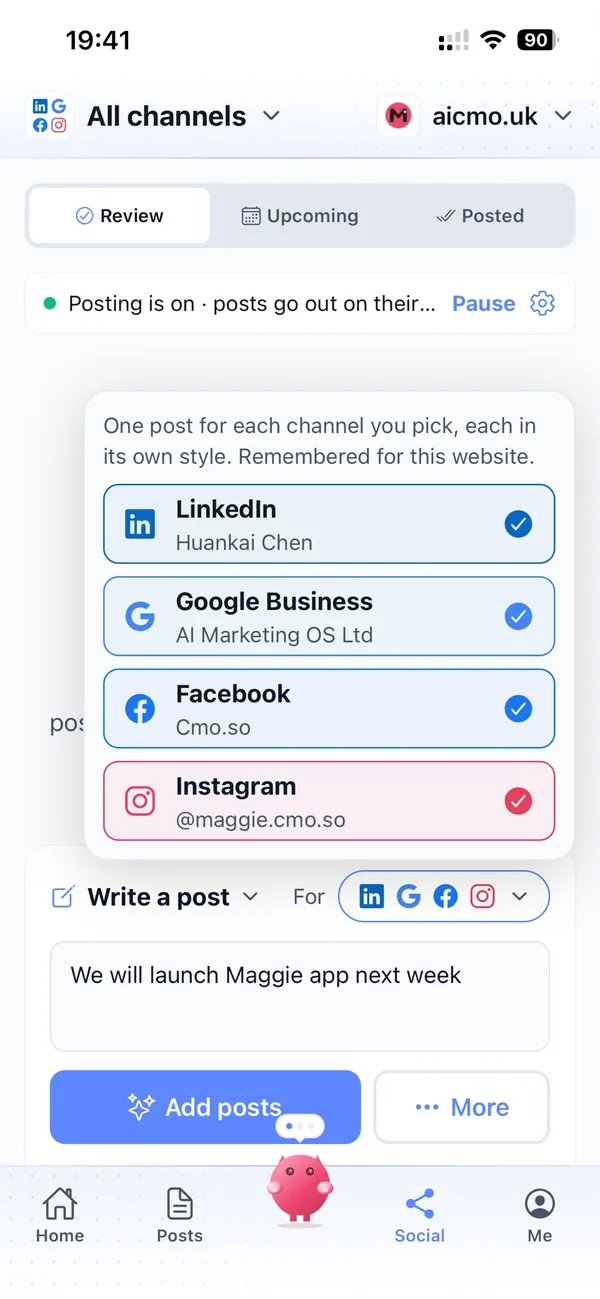
From your organisation's website to a term of posts in four steps
Enter your website
Maggie reads it and drafts your organisation's brand profile in minutes.
Check your profile
Correct your research themes and current projects, add the audiences you want to reach and choose your channels.
Review the drafts
Summaries, project updates and event posts arrive with pictures. Approve, edit or skip each one.
Let them go out
Approved posts go out at each channel's times and every one comes back with its link.
Why not just…
The usual ways research organisations try to get their work seen, and where each one runs out.
…leave it to the press office?
A central press office picks the few stories with the widest appeal. The steady stream of papers, projects and seminars still needs telling, and that's the part Maggie writes every week.
…ask each researcher to post?
Some will, most won't, and each writes in a different voice. With Maggie drafting from your profile, researchers only need to check the facts.
…hire a communications officer?
A full-time marketing hire in the UK costs around £3,000 a month before tools, often more than a grant line allows. Maggie writes and publishes every week from £15 a month.
…paste the abstract into ChatGPT?
You still brief it each time, check it, make a picture and post it by hand, and it doesn't know your projects or audiences. Maggie remembers your organisation and keeps the schedule going.
Cut the £5,900/mo marketing bill to £15/mo
Everything a marketing team does, done by Maggie.
| What needs doing | Without cmo.so | With cmo.so |
|---|---|---|
| Full-time marketing hire | £3,000/mo | Included |
| SEO and AI search (GEO) agency | £1,000/mo | Included |
| Content writer, AI-assisted | £500/mo | Included |
| Social media manager, freelance | £800/mo | Included |
| Designed pictures for every post | £300/mo | Included |
| SEO and GEO softwareRank tracking, site audits, AI visibility | £250/mo | Included |
| AI writing and image tools | £50/mo | Included |
| Working hours | Office hours | 24/7 |
| Total per month | £5,900+ | From £15/mo |
Typical UK costs for a small business in 2026, with AI already cutting freelance rates. Estimates only; your own quotes will vary.
- 5 social posts, 30 once verified
- 15 Maggie messages a day
- Upgrade any time
- 12 posts a day
- 150 Maggie messages a day
- All channels
- 96 posts a day
- 1,000 Maggie messages a day
- All channels
Per website, billed monthly. Blog and social posts share one allowance; your best plan sets how much you can talk to Maggie across all your websites.
Marketing automation for research organisations: your questions
Still unsure?
What is marketing automation for research organisations?
It's software that does the repeating work of communicating research: turning papers and projects into plain-English posts, promoting events, making pictures and publishing on schedule.
With cmo.so, Maggie does all of it from your organisation's website, and nothing goes out until someone on your team approves it.
How do research organisations reach more people online?
Research organisations reach more people online by explaining each finding in plain language, on their own website and on LinkedIn, and by promoting events well before they happen.
Maggie writes those posts every week, links them back to the full papers, and Search Console shows which explainers bring readers to your website.
How much does marketing automation cost for a research organisation?
There's a free plan with no card needed. Paid plans are per website and billed monthly: Air at £15 a month covers two posts a day, which suits a single institute or centre, and Pro at £45 a month suits an organisation posting on several channels.
Founding members get lower prices for good on every plan until 1 January 2027. You can cancel any time.
Which channels should research organisations start with?
Most research organisations start with their own website and LinkedIn, because that's where funders, partners and policymakers look for evidence of your work.
Google Business helps if you hold public lectures or have a building people visit, and YouTube is in beta for recorded talks. Each channel has its own posting times and queue.
Will the summaries get our findings right?
They start from your own pages and papers, and every summary is checked by your team before it goes out. Approvals are on by default for that reason.
Ask the researcher who did the work to review it, edit any sentence that overstates a result, and Maggie learns from those edits for the next post.
Can we hold a post until a paper is published?
Yes, you can. Nothing goes out until it's approved, so you can leave a draft unapproved until the publication date and approve it on the day.
You can also pause a channel at any time if plans change.
Can cmo.so write for funders and for the public at once?
Yes. One idea becomes a post for each channel in its own style, so a finding can be a detailed LinkedIn post for partners and a short, friendly explainer for the public.
Your brand profile sets the audiences, and you can adjust the voice for each channel.
We have several labs and centres. Can cmo.so handle them?
Yes. If each lab or centre has its own website, add them all to one account and each gets its own brand profile, channels, schedule and approvals.
If they share one website, Maggie can plan posts for each research theme from the same brand profile.
Does it write grant applications or reports?
No, it doesn't. It writes and publishes blog and social posts, not grant applications, funder reports or papers. Those stay with your researchers and grants team.
The posts can still help, because they give you a record of your work reaching people that you can point funders to.
Is it safe to let AI post for a research organisation?
Yes, because nothing goes out until it's approved. Approvals are on by default, and you can keep them on for every channel.
Social channels connect through each platform's official sign-in, so cmo.so never sees your passwords. cmo.so never sells or rents your data, and Search Console data is never used to train AI models.
Can our researchers approve posts about their own work?
Yes. In Me → Team you can add people and choose what each can see or change, using presets such as editor or manager.
So the comms lead can run the schedule while each researcher checks the posts about their project.
Let your next paper reach beyond the journal
Enter your organisation's website. Your brand profile and first week of research summaries and event posts are ready in minutes, and nothing goes out until your team approves it.
- Free plan, no card needed
- You approve every post
- Cancel any time