


Marketing automation for public sector organisations
Residents need to know about the new bin days, the library's holiday hours and the consultation that closes on Friday. Maggie, your AI CMO, drafts clear, plain-English posts for your website and channels, and nothing goes out until your team approves it.
Free to start · No credit card · 30 free posts
Used by 600+ users and trusted by teams at
aeglesriphal.com
moonlakespa.com
shop.theteagroup.com
clo100.com
logtrics.io
mymorez.com
nextidal.com
otisapp.com
storaitelling.com
theheatpumps.co.uk
web-translations.com
exposeai.tech
orielipo.com
whitelabelcrowd.fund
elliptic.co
med.moonlakespa.com
netdex.co.il
orawellness.uk
reenest.com
syngage.ai
thepenthouseliving.com
zengolf.studio
imaintain.uk
rebuildingsociety.com
aurasocial.world
goaimex.com
moneyparents.com
newgenrenewables.uk
osmosisai.co
saunders.ac
teeza.app
thursdayclub.com
Why public sector comms teams are always catching up
A small team serves a whole area, every service wants its news out today, and every word is read closely.
Every service wants a post
Libraries, leisure centres, waste, parking, events, recruitment. Each team sends a request, and a comms team of three is writing the same kind of update all week instead of planning.
Residents can't find the answer
People search "when is my bin collection" or "is the tip open on bank holidays" and land on an old PDF. Then they phone, and the contact centre takes the strain.
Consultations get a handful of replies
A consultation goes up on the website and gets one post at launch. The people most affected never hear about it until the decision is made.
Every word is scrutinised
Tone, accuracy, accessibility and the rules for the pre-election period all matter. Drafting carefully takes time, and the easiest thing is to say less.

A new garden waste service on Monday. Every channel explains it by Wednesday.
It's Monday. The garden waste subscription opens for sign-ups next week, the leisure centre has new swimming times and a parks consultation closes in three weeks. Your inbox has a request for each.
You paste your organisation's website into cmo.so. Maggie reads it and writes your brand profile: the services you run, the towns and villages you cover, the residents, businesses and partners you speak to, and the plain, friendly voice your style guide asks for. You correct one detail and switch on Content Policy Guard with your house rules: no jargon, no party political content and always link to the official page.
By Wednesday the drafts are waiting: a website news post explaining the garden waste service in plain English, a Facebook post for residents with the sign-up date, a Google Business update for the leisure centre's new times, and three posts spread across the consultation period reminding people to have their say. One post mentions a councillor in a way your house rules flag, so it's held as a draft with a suggested rewrite. Your team lead checks the batch and approves it from the web app.
The posts go out at the times you set for each channel, and each comes back with its link. Search Console in cmo.so shows which service pages residents are finding, so you can see whether fewer people need to phone.
Clear public information, published on time
Each of those problems has an answer, and your team still signs off everything published in your organisation's name.
Plain-English service updates
Changes to services, opening hours, roadworks and new schemes explained clearly for residents, written for Google and for AI answers so people find the answer before they phone. Published to WordPress or any site through the cmo.so API.
Website newsConsultations people hear about
A consultation becomes a series: an explainer at launch, reminders for each channel and a final call before it closes, each in that channel's style.
Campaign seriesYour house rules, checked
Content Policy Guard checks posts against your own house rules, such as no jargon or no political content, and holds a risky post as a draft with a suggested rewrite. These are AI suggestions, not legal or compliance advice: a qualified person should still review, and you stay responsible for what you publish.
Content Policy GuardEvery service, one voice
Enter your website and Maggie builds your brand profile: services, residents and partners, what makes your area distinctive and your house style. Every post starts from it, whichever team asked for it.
Brand profileLocal places, easy to find
Libraries, leisure centres, museums and recycling centres often have their own Google Business profiles. Regular posts keep their times, events and news current where residents look.
Google BusinessApprovals that fit your sign-off
By default nothing goes out until it's approved. Add colleagues in Me → Team with presets such as editor or manager, keep approvals on for every channel and pause a channel whenever you need to.
Team approvalsYour marketing team, in your pocket
Real screens from the cmo.so app on iPhone.
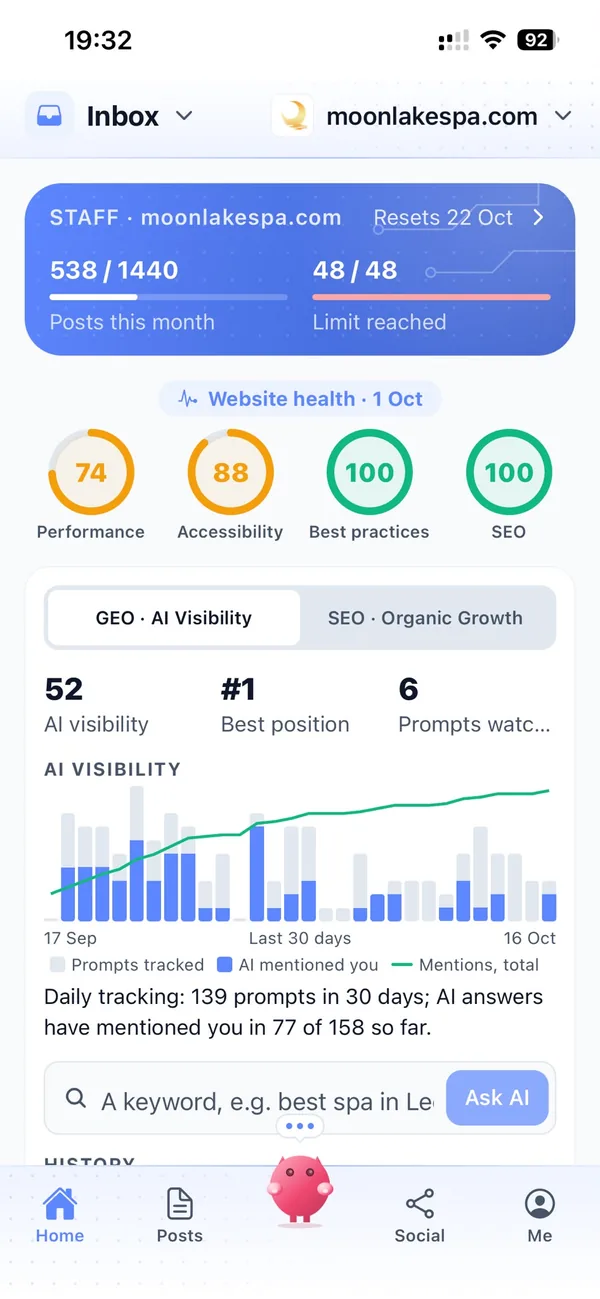
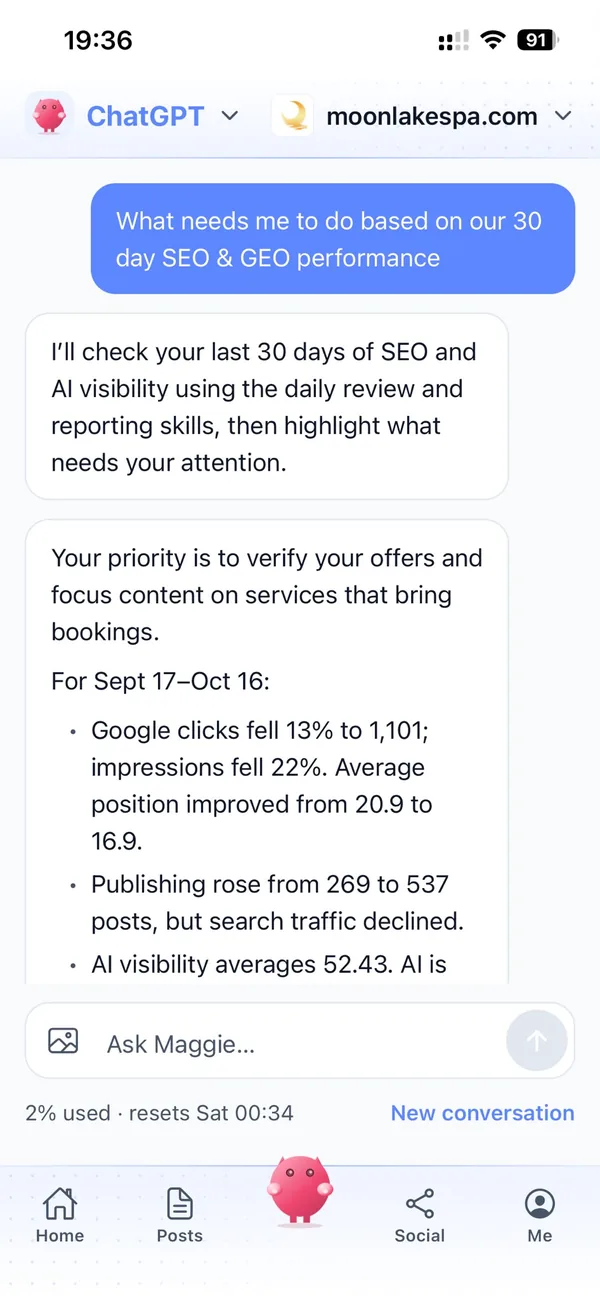
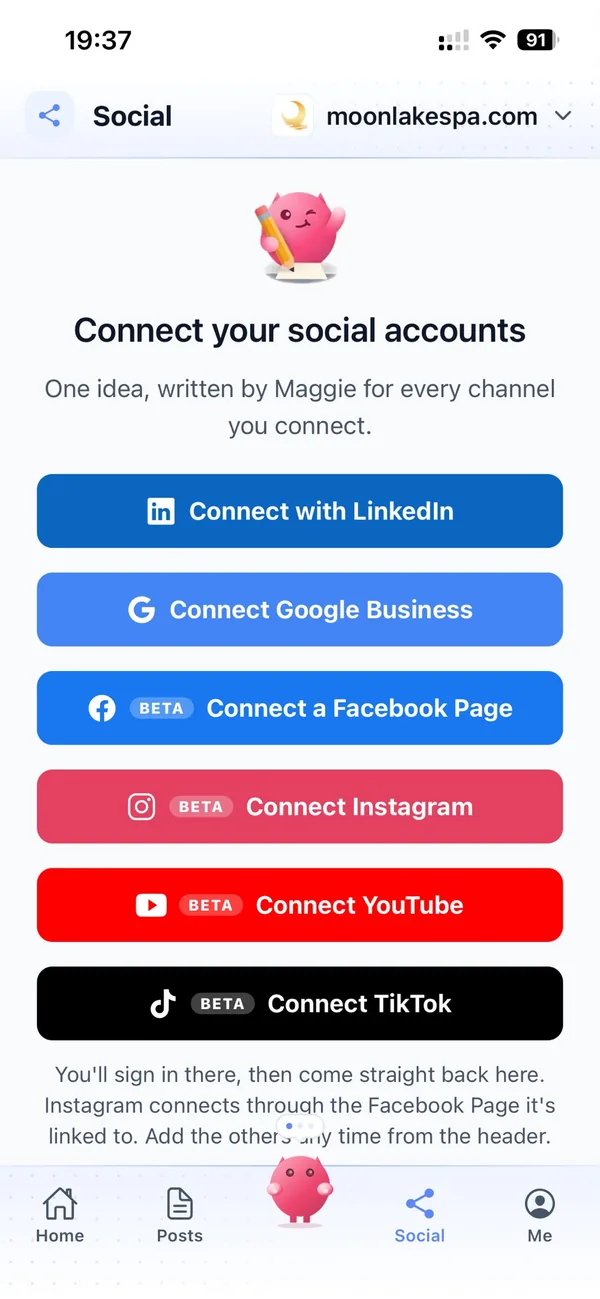
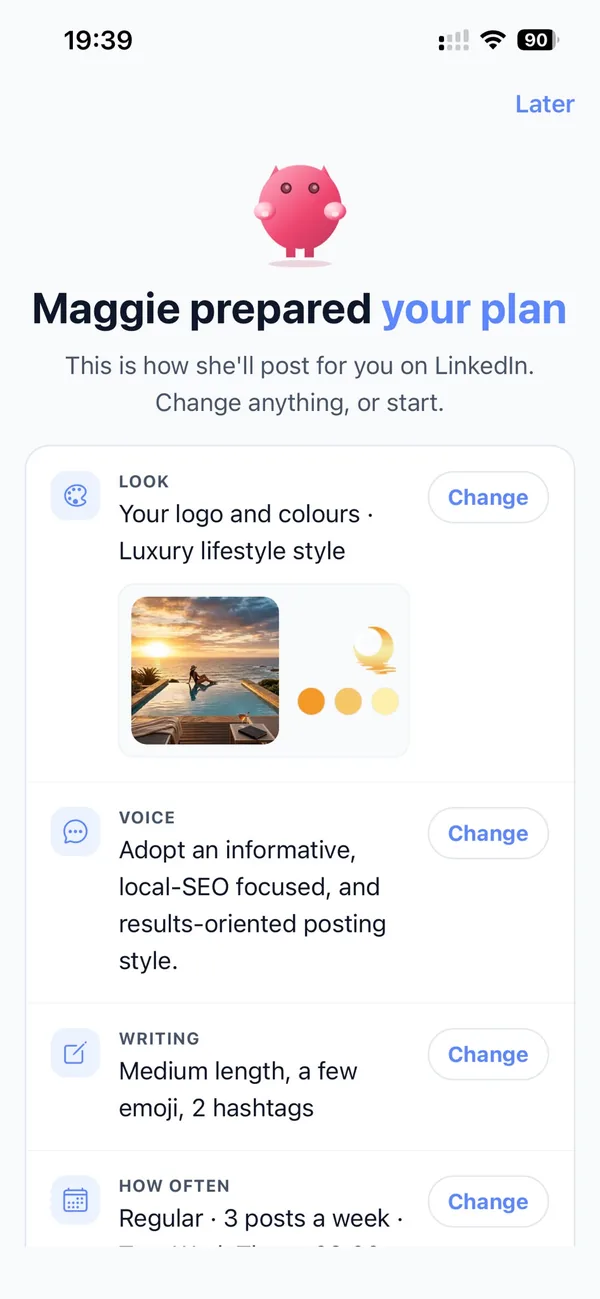
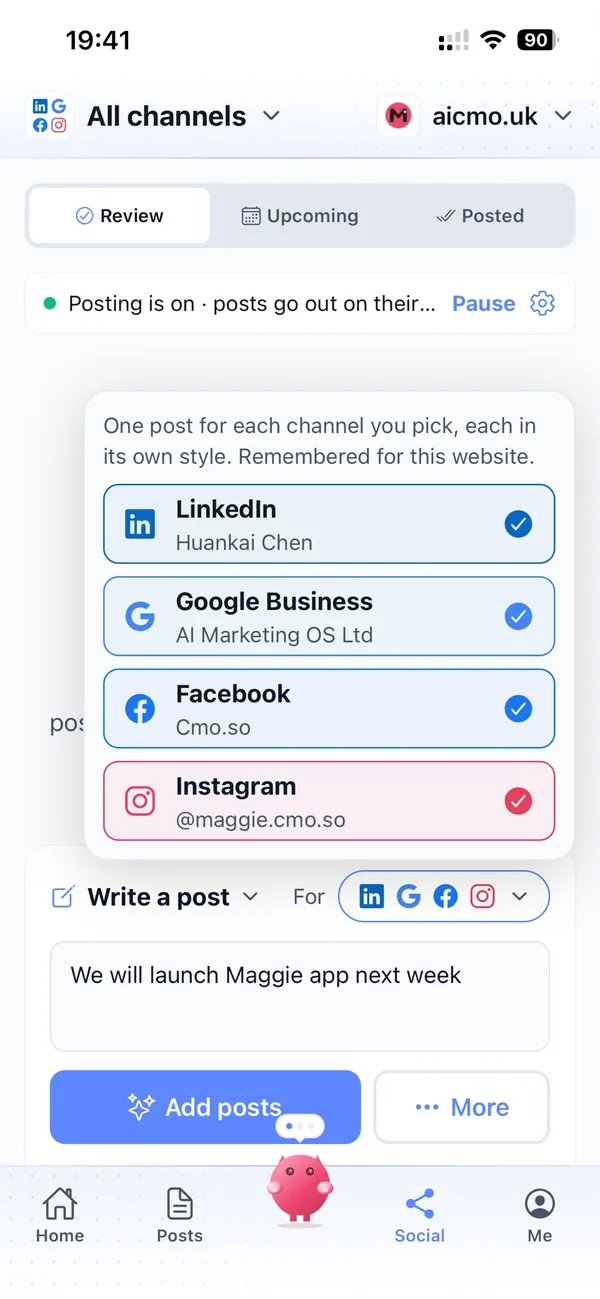
From your website to a steady flow of service news in four steps
Enter your website
Maggie reads it and drafts your organisation's brand profile in minutes.
Check your profile and rules
Correct your services and house style, and add house rules if you switch on Content Policy Guard.
Review the drafts
Your first week of posts arrives with pictures. Approve, edit or skip each one.
Let them go out
Approved posts go out at each channel's times and every one comes back with its link.
Why not just…
The usual ways public bodies keep information flowing, and where each one runs out.
…ask each service to post its own updates?
You get ten different voices, some posts nobody checks and some services that never post at all. Maggie writes everything from one brand profile, and your team approves it.
…recruit another comms officer?
A full-time marketing hire in the UK costs around £3,000 a month before tools, and recruitment takes months. Maggie drafts the routine updates so your existing team can focus on the sensitive ones.
…rely on press releases?
Local papers pick up some of them, but residents search the web and scroll Facebook. Posts on your own website and channels reach them directly.
…write it with ChatGPT?
Someone still briefs it every time, checks it against the style guide, makes the picture and posts it. Maggie remembers your house style and rules and publishes on schedule.
Cut the £5,900/mo marketing bill to £15/mo
Everything a marketing team does, done by Maggie.
| What needs doing | Without cmo.so | With cmo.so |
|---|---|---|
| Full-time marketing hire | £3,000/mo | Included |
| SEO and AI search (GEO) agency | £1,000/mo | Included |
| Content writer, AI-assisted | £500/mo | Included |
| Social media manager, freelance | £800/mo | Included |
| Designed pictures for every post | £300/mo | Included |
| SEO and GEO softwareRank tracking, site audits, AI visibility | £250/mo | Included |
| AI writing and image tools | £50/mo | Included |
| Working hours | Office hours | 24/7 |
| Total per month | £5,900+ | From £15/mo |
Typical UK costs for a small business in 2026, with AI already cutting freelance rates. Estimates only; your own quotes will vary.
- 5 social posts, 30 once verified
- 15 Maggie messages a day
- Upgrade any time
- 12 posts a day
- 150 Maggie messages a day
- All channels
- 96 posts a day
- 1,000 Maggie messages a day
- All channels
Per website, billed monthly. Blog and social posts share one allowance; your best plan sets how much you can talk to Maggie across all your websites.
Marketing automation for public sector organisations: your questions
Still unsure?
What is marketing automation for public sector organisations?
It's software that does the repeating work of public communication: planning posts around services and deadlines, writing website news and social posts, making pictures and publishing them on schedule.
With cmo.so, Maggie does all of it from your organisation's website, and nothing goes out until your team approves it.
How do public sector organisations reach more residents online?
Public sector organisations reach more residents online by answering their everyday questions clearly on their own website and repeating the key dates where people already look: Facebook, Google Business and local search.
Maggie drafts those posts every week and spreads reminders across deadlines, and Search Console in cmo.so shows which service pages people find.
How much does it cost for a public sector organisation?
There's a free plan with no card needed. Paid plans are per website and billed monthly: Air at £15 a month covers two posts a day, and Pro at £45 a month suits a team posting on several channels.
Max is £75 a month and Elite £195 a month for organisations with many websites or very high volumes. Founding members get lower prices for good on every plan until 1 January 2027, and you can cancel any time.
Which channels should public sector organisations start with?
Most start with their own website for service news, Facebook (in beta) for residents and Google Business for places people visit, such as libraries and leisure centres.
LinkedIn suits recruitment and partner news, and Instagram is in beta. Each channel has its own posting times and queue.
Can it follow our style guide and house rules?
Yes. Your brand profile records your voice and house style, and Content Policy Guard can check each post against rules you set, holding a risky one as a draft with a suggested rewrite.
These are AI suggestions, not legal or compliance advice. A qualified person should still review, and your organisation stays responsible for what it publishes.
What about the pre-election period?
You stay in control of it. You can pause any channel at any time, keep approvals on for everything and add a house rule about political content so risky posts are held as drafts.
Your team decides what is appropriate during that period; cmo.so only publishes what someone has approved.
Is it safe to let AI write public information?
It is when people stay in charge. By default nothing goes out until it's approved, and posts start from your brand profile, which your team checks.
Social channels connect through each platform's official sign-in, so cmo.so never sees your passwords, and cmo.so never sells or rents your data.
Does it connect to our case management or resident records?
No, cmo.so doesn't connect to those systems. Maggie writes and publishes posts; she doesn't connect to booking, case or client record systems.
She works only from your website, your brand profile and what you tell her.
Can it write in plain English for everyone?
Yes. Ask for short sentences and no jargon in your brand profile and Maggie, your AI CMO, writes that way, and she learns from every edit your team makes.
Each post is still reviewed by your team, so you can check it against your own accessibility guidance.
We run several services with their own websites. Can cmo.so handle them?
Yes. Add each website to one account and each gets its own brand profile, channels, schedule and approvals.
So the museum, the leisure trust and the main website can each keep their own voice and their own approvers.
Can it help residents find us in AI answers?
It can help. Maggie writes clear, quotable answers to common questions, which is the kind of text AI answers draw on, though nobody can promise a mention.
AI visibility in cmo.so shows how Google's AI answers describe your organisation, so you can see whether they give residents the right information.
Can different teams request posts?
Yes. Colleagues you add in Me → Team can suggest and edit posts, with presets such as editor or manager deciding what each person can see or change.
Approvals, edits and changes are kept in one place, so you always know who approved what.
Get the right information to residents before they need to phone
Enter your organisation's website. Your brand profile and first week of posts are ready in minutes, and nothing goes out until your team approves it.
- Free plan, no card needed
- You approve every post
- Cancel any time