


Marketing automation for AR and VR companies
Your work is easy to love once someone puts on a headset, and hard to explain in a post. Maggie, your AI CMO, writes the explainers, project stories and LinkedIn posts that get buyers to the demo, and you approve every one.
Free to start · No credit card · 30 free posts
Used by 600+ users and trusted by teams at
aeglesriphal.com
moonlakespa.com
shop.theteagroup.com
clo100.com
logtrics.io
mymorez.com
nextidal.com
otisapp.com
storaitelling.com
theheatpumps.co.uk
web-translations.com
exposeai.tech
orielipo.com
whitelabelcrowd.fund
elliptic.co
med.moonlakespa.com
netdex.co.il
orawellness.uk
reenest.com
syngage.ai
thepenthouseliving.com
zengolf.studio
imaintain.uk
rebuildingsociety.com
aurasocial.world
goaimex.com
moneyparents.com
newgenrenewables.uk
osmosisai.co
saunders.ac
teeza.app
thursdayclub.com
Why AR and VR companies struggle to market what they build
Your team spends its weeks in Unity and Unreal, on client calls and at demo days. The website still shows the project from two headsets ago.
A 3D experience in a flat post
A walk-through of a factory floor or an AR try-on is magic in the headset and a blurry clip on LinkedIn. Without words around it, buyers don't see what it would do for them.
Buyers don't know what to ask for
A training manager has heard VR could help with safety training, but doesn't know the difference between 360 video and a full simulation, or what a pilot involves. Nobody has written it down for them.
The best projects are under NDA
Your most impressive work sits behind client confidentiality, so the portfolio looks thin. What you can share, your approach and your know-how, rarely makes it onto the blog.
The hype moves faster than you post
A new headset launches and every buyer asks whether they should wait. If you don't publish a calm answer, a gadget site's review is what they read instead.
A training simulation ships on Monday. Buyers understand it by Friday.
It's Monday, and your studio has just handed over a VR fire-safety simulation to a manufacturing client. They're happy, but you can't name them, and nothing about the project is on your site.
You've already given cmo.so your website, so Maggie knows your services in VR training, AR product visualisation and WebAR campaigns, the industries you sell to, the studios you compete with and the straightforward way you talk to non-technical buyers. You tell her what you can share about the project without naming the client.
By Wednesday the drafts are waiting, each with a picture in your brand's look: a blog post on when VR training makes sense and when a video would do, an anonymised project story about practising emergencies safely, two LinkedIn posts for heads of learning and health and safety managers, and a short explainer on what a first pilot involves. Your creative director tightens one sentence and approves the rest from the iPhone app.
The posts go out at the times you set for each channel, each reported back with its link. Next month Search Console in cmo.so shows which explainers people found, and AI visibility shows whether Google's AI answers mention your studio when someone asks who builds VR training.
Marketing that explains immersive work in plain words
Each of those problems has an answer, and you still decide what goes out under your studio's name.
Explainers buyers actually search for
Posts on AR versus VR versus mixed reality, what VR training costs to plan, how WebAR works without an app, and how to run a pilot, written for Google and for AI answers. Published to WordPress, Shopify, Wix, Webflow or any site through the cmo.so API.
Blog on autopilotProject stories you're allowed to tell
Once you tell Maggie what you can share, she writes the story around the problem, the approach and what users do in the experience, without names you can't publish. You approve every word.
Project storiesLinkedIn for the people who sign off
Weekly posts for heads of learning, marketing directors, museum and venue teams and product designers, in your studio's voice and on the days and times you choose.
LinkedInShe knows your stack and your rivals
Enter your website and Maggie builds a brand profile: your services, the sectors you sell to, what sets you apart, a SWOT, your competitors and your voice. Every post starts from it, and you can correct any part.
Brand profileDemos where people watch them
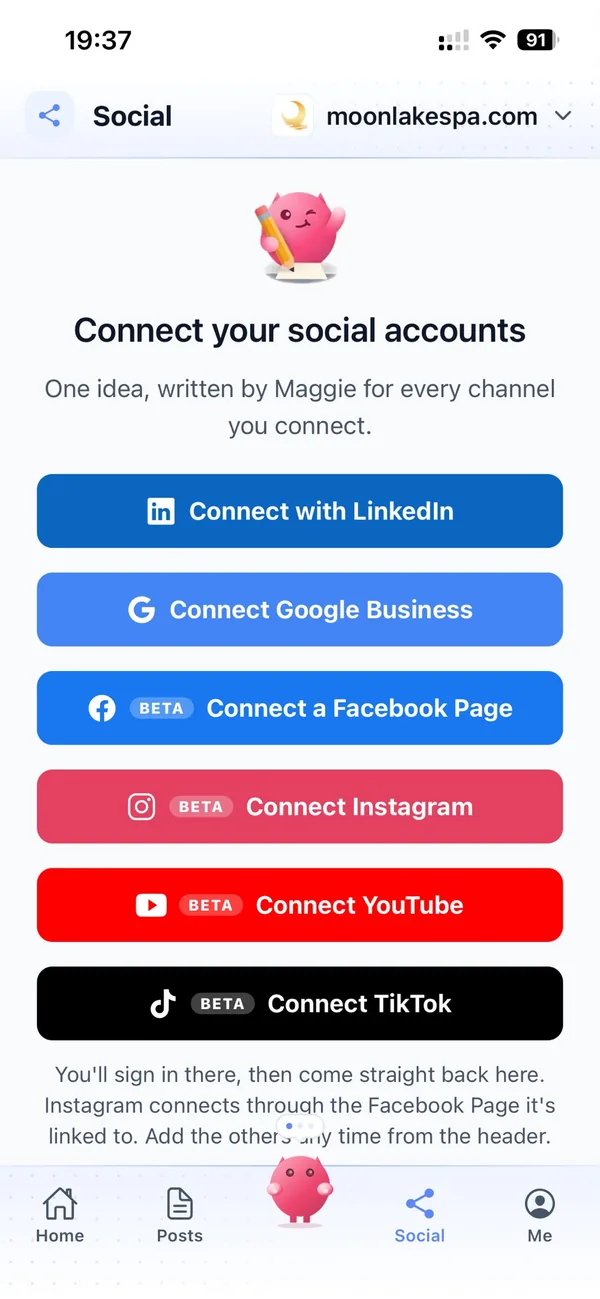
One project becomes a blog post, a LinkedIn post and, in beta, posts for YouTube, TikTok, Instagram and Facebook, each in that channel's style. Uploaded videos are only used to post them and deleted within 7 days.
Every channelSee if search and AI find you
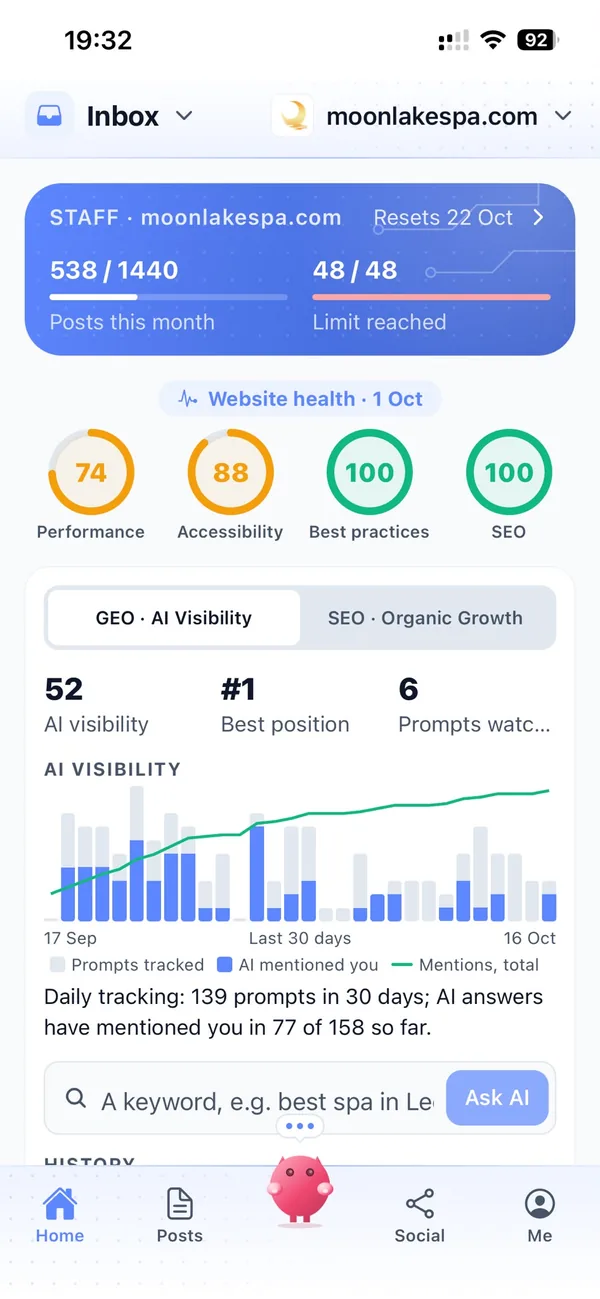
Search Console in cmo.so shows which posts bring people in. AI visibility shows how Google's AI answers describe your company when buyers ask who builds AR or VR experiences.
Search Console and AI visibilityYour marketing team, in your pocket
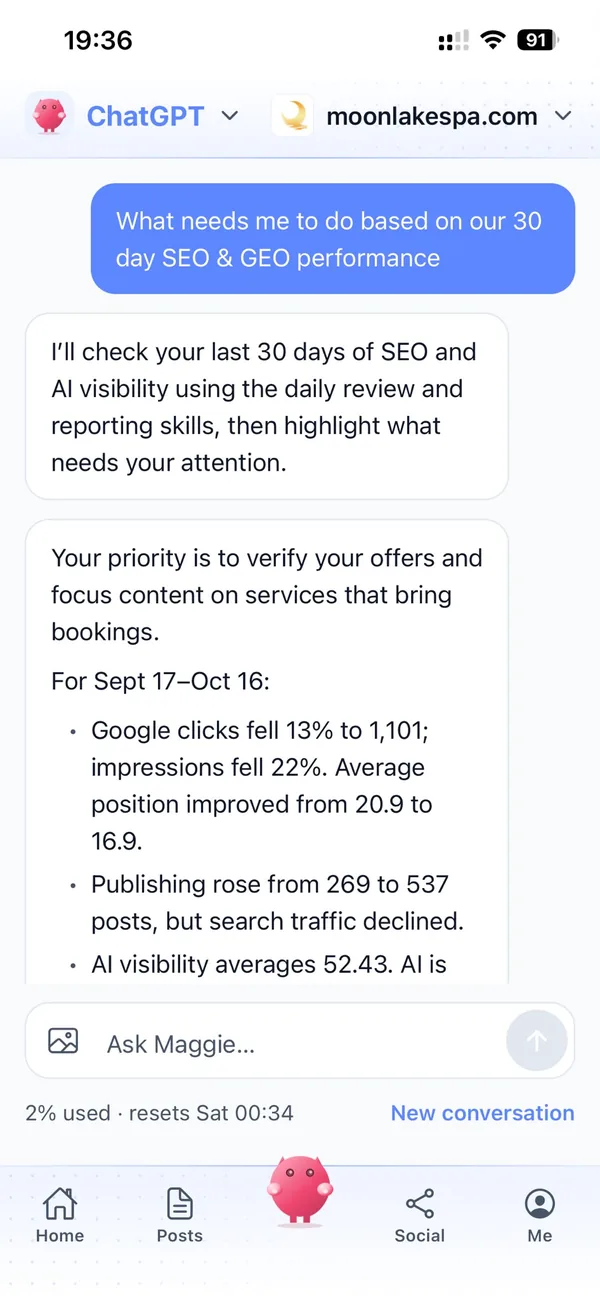
Real screens from the cmo.so app on iPhone.
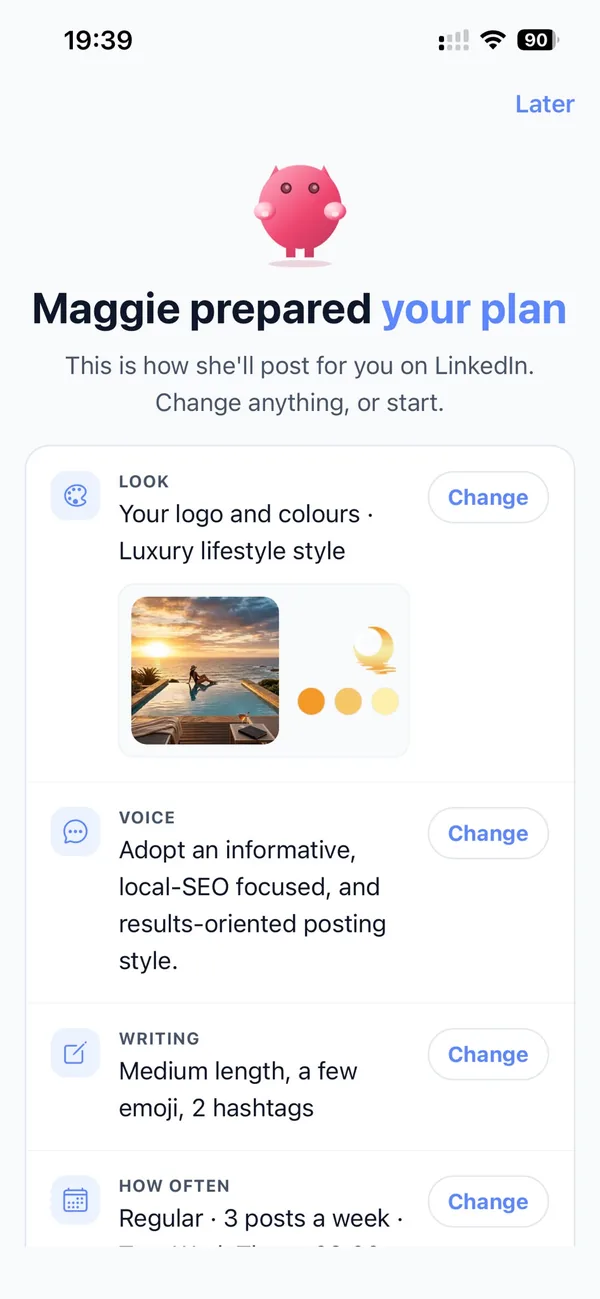
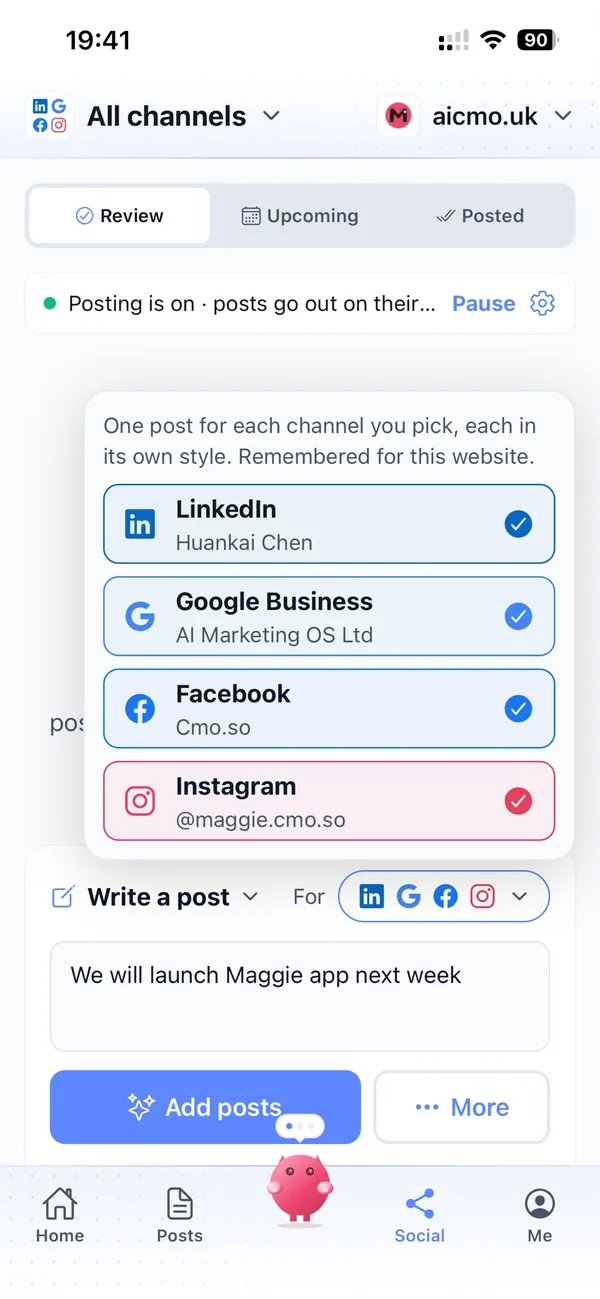
From your studio's website to a steady stream of posts in four steps
Enter your website
Maggie reads your services and portfolio and drafts your brand profile in minutes.
Check your profile
Correct your services, add the sectors you want to win and choose your channels.
Review the drafts
Your first week of posts arrives with pictures. Approve, edit or skip each one.
Let them go out
Approved posts go out at each channel's times and every one comes back with its link.
Why not just…
The usual ways immersive studios try to win work, and where each one runs out.
…rely on trade shows and demo days?
A headset on a stand wins a few great conversations, then the stand comes down. Posts on your blog and LinkedIn keep explaining your work to the buyers who weren't there.
…let the showreel do the talking?
A showreel looks impressive, but it doesn't answer a buyer's questions about cost, hardware or rollout. Maggie writes the words that turn a good-looking clip into a reason to call.
…hire a marketing manager?
A full-time marketing hire in the UK costs around £3,000 a month before tools, and needs time to learn the technology. Maggie starts from your website today, from £15 a month.
…write it with ChatGPT?
You still brief it, check it, make the pictures and post it yourself, and it doesn't remember your projects or your sectors. Maggie keeps your brand profile and puts posts out on schedule.
Cut the £5,900/mo marketing bill to £15/mo
Everything a marketing team does, done by Maggie.
| What needs doing | Without cmo.so | With cmo.so |
|---|---|---|
| Full-time marketing hire | £3,000/mo | Included |
| SEO and AI search (GEO) agency | £1,000/mo | Included |
| Content writer, AI-assisted | £500/mo | Included |
| Social media manager, freelance | £800/mo | Included |
| Designed pictures for every post | £300/mo | Included |
| SEO and GEO softwareRank tracking, site audits, AI visibility | £250/mo | Included |
| AI writing and image tools | £50/mo | Included |
| Working hours | Office hours | 24/7 |
| Total per month | £5,900+ | From £15/mo |
Typical UK costs for a small business in 2026, with AI already cutting freelance rates. Estimates only; your own quotes will vary.
- 5 social posts, 30 once verified
- 15 Maggie messages a day
- Upgrade any time
- 12 posts a day
- 150 Maggie messages a day
- All channels
- 96 posts a day
- 1,000 Maggie messages a day
- All channels
Per website, billed monthly. Blog and social posts share one allowance; your best plan sets how much you can talk to Maggie across all your websites.
Marketing automation for AR and VR companies: your questions
Still unsure?
What is marketing automation for AR and VR companies?
It's software that does the repeating content work of an immersive technology company: explaining what AR and VR can do, telling project stories, posting on LinkedIn and publishing on schedule.
With cmo.so, Maggie does all of it from your website and brand profile, and nothing goes out until you approve it.
How do AR and VR companies get more clients online?
AR and VR companies win more clients online by answering the questions buyers have before they commit: what the technology can do for their sector, what a pilot looks like, what hardware it needs and how it's rolled out.
Maggie writes those explainers and project stories every week, posts them on LinkedIn where decision makers look, and Search Console in cmo.so shows which ones bring people to your site.
How much does cmo.so cost for an AR or VR company?
There's a free plan with no card needed. Paid plans are per website and billed monthly: Air at £15 a month covers two posts a day, and Pro at £45 a month suits a growing studio posting on several channels.
Founding members get lower prices for good on every plan until 1 January 2027, and you can cancel any time.
Which channels should AR and VR companies start with?
Most start with their blog for explainers and project stories, plus LinkedIn, where training, marketing and innovation leads decide who to talk to.
YouTube and TikTok are in beta and suit demo clips, and Instagram and Facebook are in beta too. Each channel has its own posting times and queue.
Is it safe to let AI write about our client projects?
It is, because nothing goes out until you approve it. Approvals are on by default, so you can check that every project story leaves out anything under NDA.
Maggie only writes what's in your brand profile and what you tell her, and cmo.so never sells or rents your data. Social channels connect through each platform's official sign-in, so cmo.so never sees your passwords.
How can cmo.so help when our best work is confidential?
It helps you share what you're allowed to: the type of problem, your approach, what users do in the experience and what you learned, without naming the client.
You can also have Maggie write about your methods, from storyboarding to user testing in the headset, which shows expertise without showing the project.
Can it post our demo videos?
It can post them to the channels that support video. YouTube, TikTok, Instagram and Facebook are in beta, and one idea can become a post for each, written in that channel's style.
Uploaded videos are only used to post them and are deleted within 7 days.
What does cmo.so write when a new headset launches?
She can write a calm, practical post for your buyers on what the new device changes for projects like theirs and whether it's worth waiting for, based on what you tell her.
You review it before it goes out, so your team can check any technical detail first.
We sell to several sectors. Can it write for each one?
It can. Your brand profile lists the sectors you serve, such as training, retail, property or museums, and Maggie plans topics for each so every buyer sees posts that speak to their world.
If you run separate websites for different sectors or products, add each to one account with its own brand profile, channels, schedule and approvals.
Can it help us appear in AI answers about immersive technology?
It can help. Maggie writes articles with clear, quotable answers to the questions buyers ask, which is what AI tools draw on.
AI visibility in cmo.so shows how Google's AI answers currently describe your company, so you can follow how that changes over time.
Can our developers use cmo.so from their own tools?
They can. cmo.so connects to ChatGPT and Claude, and developers can use the cmo.so MCP server and CLI, with the same approvals as the web app.
So a developer can tell Maggie what shipped in a build without leaving the tools they already use.
Help buyers see what you see in the headset
Enter your website. Your brand profile and first week of explainers, project stories and LinkedIn posts are ready in minutes, and nothing goes out until you approve it.
- Free plan, no card needed
- You approve every post
- Cancel any time