


Marketing automation for technology companies
Your team ships new features, integrations and fixes every month, and almost none of it reaches the people choosing a supplier. Maggie, your AI CMO, turns what you build into explainers, release posts and LinkedIn updates, and you approve every one.
Free to start · No credit card · 30 free posts
Used by 600+ users and trusted by teams at
aeglesriphal.com
moonlakespa.com
shop.theteagroup.com
clo100.com
logtrics.io
mymorez.com
nextidal.com
otisapp.com
storaitelling.com
theheatpumps.co.uk
web-translations.com
exposeai.tech
orielipo.com
whitelabelcrowd.fund
elliptic.co
med.moonlakespa.com
netdex.co.il
orawellness.uk
reenest.com
syngage.ai
thepenthouseliving.com
zengolf.studio
imaintain.uk
rebuildingsociety.com
aurasocial.world
goaimex.com
moneyparents.com
newgenrenewables.uk
osmosisai.co
saunders.ac
teeza.app
thursdayclub.com
Why technology companies go quiet online
The people who understand the product best are busy building it, and the marketing waits for a spare afternoon that never comes.
Releases ship in silence
A new integration goes live, the changelog gets one line and that is it. Prospects comparing suppliers never learn it exists, and customers find out by accident months later.
Experts with no time to write
Your engineers and solution architects could explain the problem better than anyone. They are also the people your roadmap and your biggest customers depend on this week.
Buyers research before they call
IT managers, operations leads and procurement teams read comparisons, ask ChatGPT for a shortlist and check your LinkedIn long before they book a demo. If you say nothing, a competitor's article answers for you.
Jargon instead of answers
Product pages written for engineers leave the finance director and the operations manager on the buying committee guessing. Nobody has had time to write the plain-English version.

The integration shipped on Thursday. By Tuesday, people knew about it.
Your team has just released a new integration that customers asked about for a year. The release notes are written, the sales team is excited, and nobody has written a word for the website or LinkedIn.
You paste your company's website into cmo.so. Maggie reads it and writes your brand profile: your platform and services, the mid-sized manufacturers and logistics firms you sell to, how you differ from the two larger suppliers you meet in every tender, and your plain, practical voice. You correct one thing: you no longer support on-premise installs.
By Monday the drafts are waiting, each with a picture in your brand's look: a blog post explaining what the integration does and who it helps, a comparison of the three ways to connect the two systems, a LinkedIn post from your CTO's point of view and a short update for existing customers. You approve the blog post, sharpen a sentence in the comparison and ask for the LinkedIn post to mention the customer feedback that started it.
The posts go out at the times you set for each channel and each one comes back with its link. A few weeks later, Search Console in cmo.so shows which explainers people are finding, and AI visibility shows how Google's AI answers describe your company when buyers ask about your category.
A marketing team that keeps up with your release cycle
Each of those problems has an answer, and your team still decides what goes out under your company's name.
Explainers buyers can follow
Blog posts that explain what your product does, how it fits with the systems buyers already run and what problem it solves, written for Google and for AI answers. Published to WordPress, Shopify, Wix, Webflow or any site through the cmo.so API.
Blog on autopilotEvery release gets its post
Tell her what shipped, or point her at the release notes page, and she writes the announcement, the how-to and the customer update, so features stop going live unnoticed.
Release postsReady for comparison searches
Buyers search for alternatives, “X vs Y” and “best tool for” before they talk to sales. Maggie writes fair, clear comparison posts so your answer is on the page they read.
ComparisonsYour positioning, not a template
Enter your website and Maggie builds your brand profile: products, buyers, unique selling points, SWOT, competitors and voice. Every post starts from it, so you stop re-explaining the company to every tool.
Brand profileLinkedIn for the buying committee
One idea becomes a LinkedIn post for decision makers, a blog post for researchers and an update for your Google Business profile, each written in that channel's style.
Every channelApprovals that fit your team
By default nothing goes out until it is approved. Add your product lead or founder in Me → Team as an editor or manager, approve from app.cmo.so or the iPhone app, and pause a channel during a launch freeze.
ApprovalsYour marketing team, in your pocket
Real screens from the cmo.so app on iPhone.
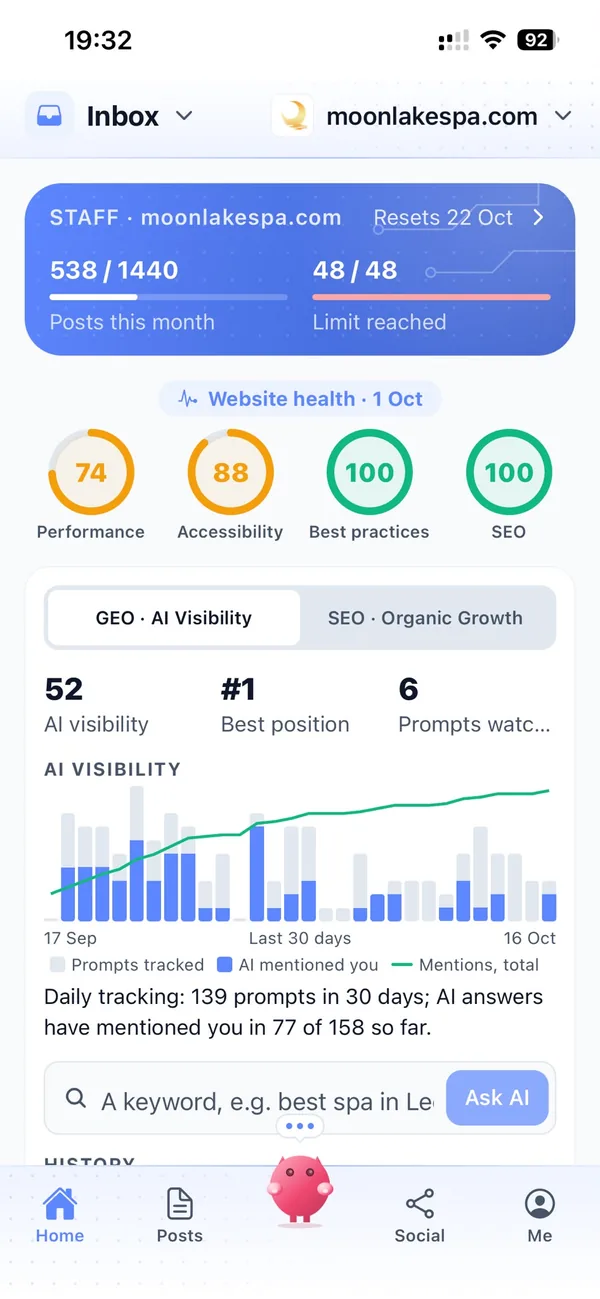
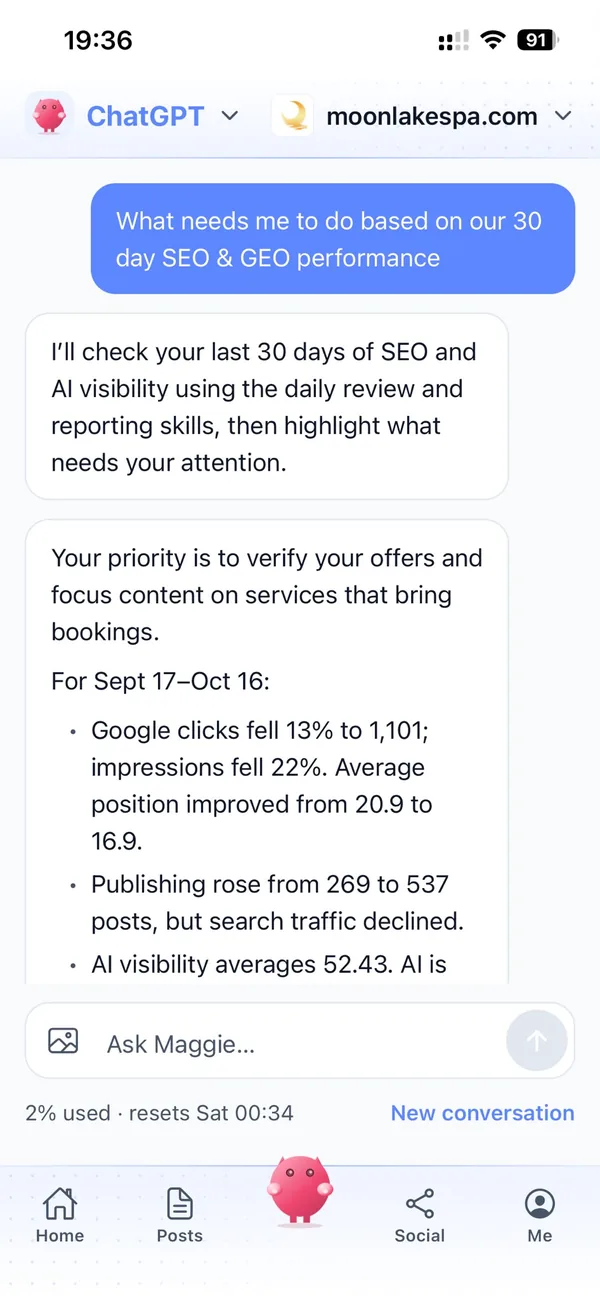
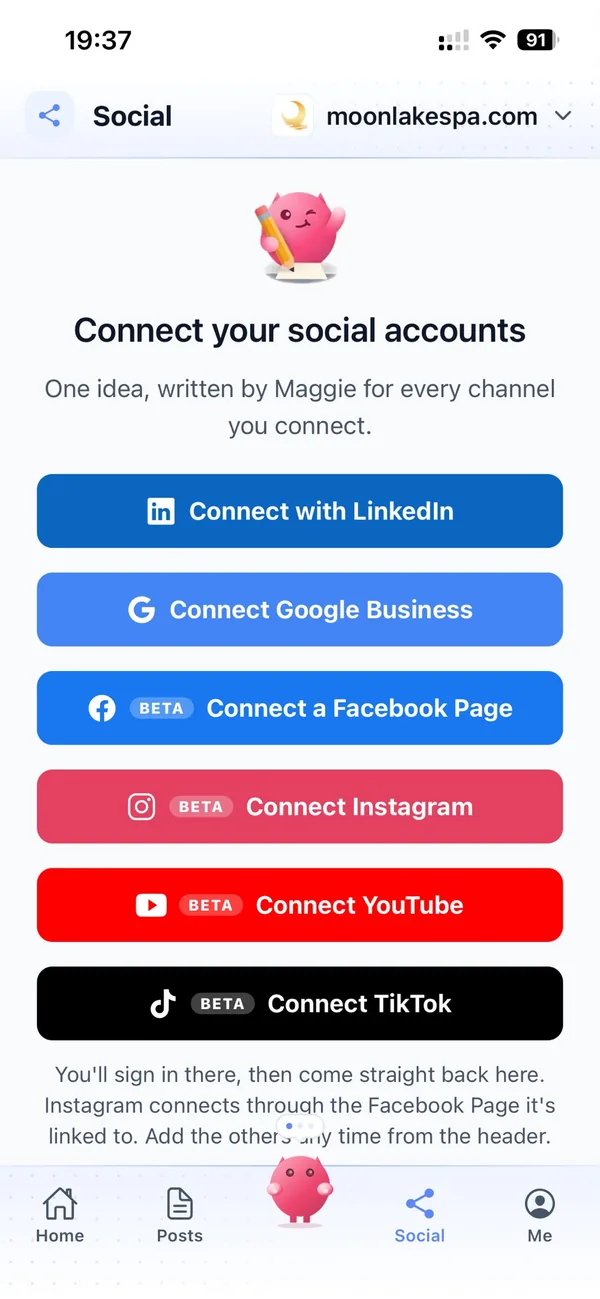
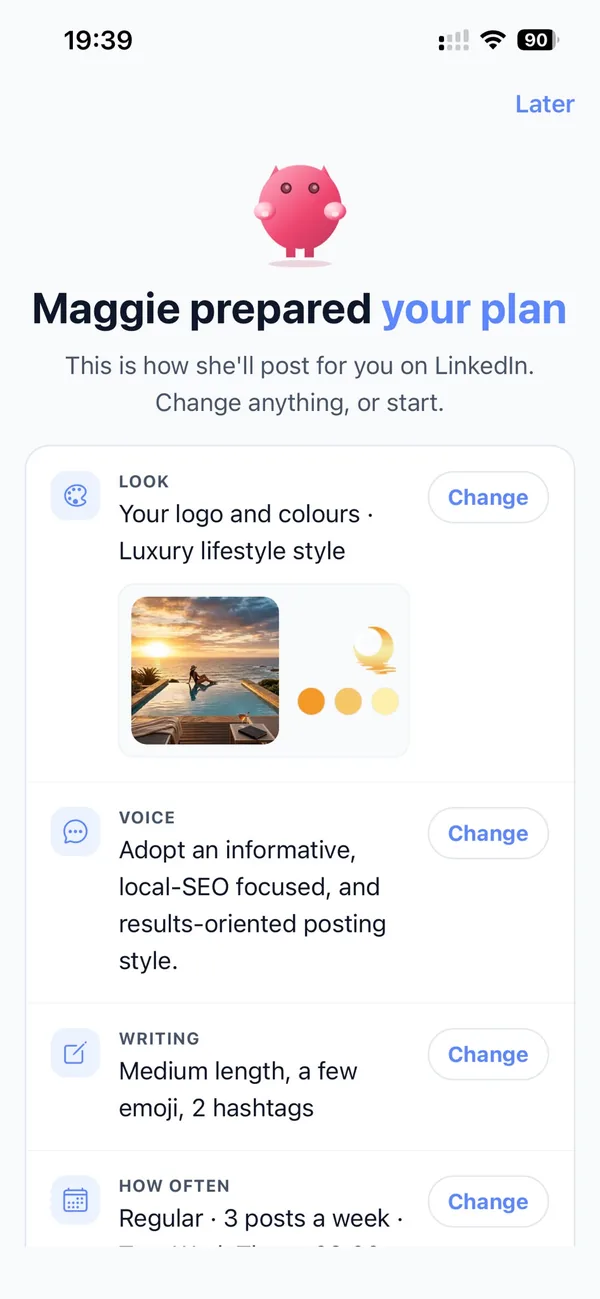
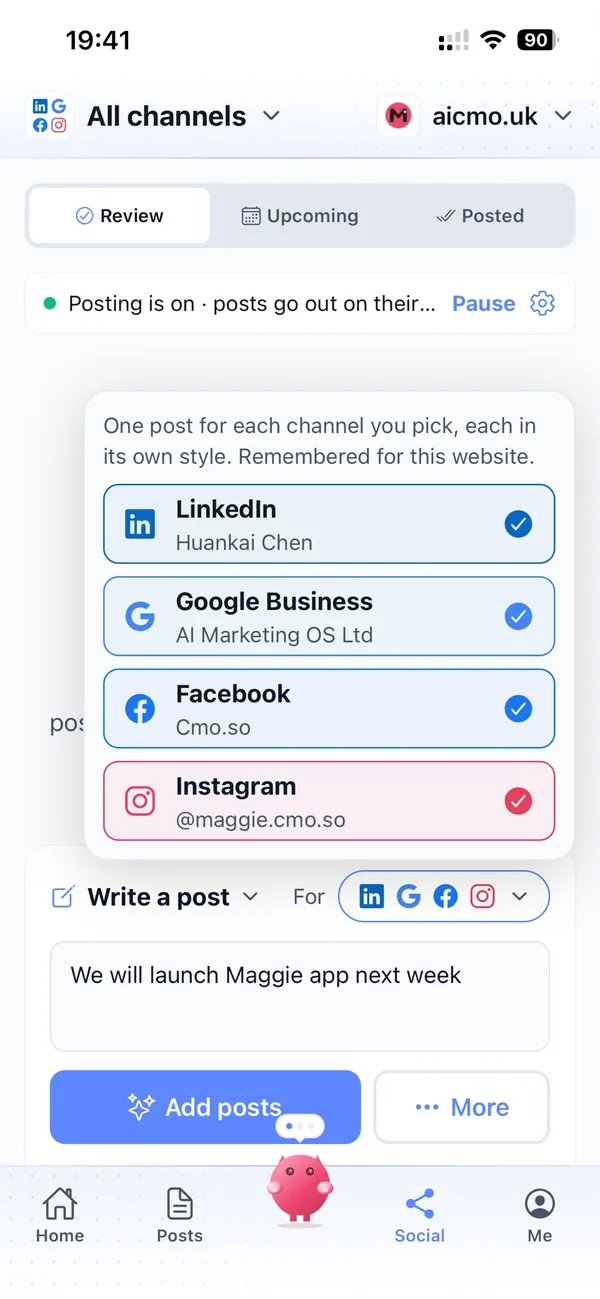
From your company's website to a steady stream of posts in four steps
Enter your website
Maggie reads it and drafts your company's brand profile in minutes.
Check your profile
Correct your products, buyers and competitors, and choose the channels you want.
Review the drafts
Your first week of explainers and posts arrives with pictures. Approve, edit or skip each one.
Let them go out
Approved posts go out at each channel's times and every one comes back with its link.
Why not just…
The usual ways technology companies try to keep their marketing in step with the product, and where each one runs out.
…hire a content marketer?
A full-time marketing hire in the UK costs around £3,000 a month before tools, and the first weeks go on learning your product and your buyers. Maggie starts from your website today.
…ask the engineers to blog?
They know the subject best, but the post always waits behind the next sprint or the next customer escalation. Maggie drafts it, and they only need to check the technical detail.
…pay a content agency?
SEO and content agencies often cost around £1,000 a month and need briefing on every release. Maggie keeps your brand profile and writes every week, from £15 a month.
…prompt ChatGPT for each post?
You still paste in your positioning, check the facts, make the picture and post it by hand. Maggie remembers your product and competitors and publishes on schedule, and you can ask her from ChatGPT or Claude too.
Cut the £5,900/mo marketing bill to £15/mo
Everything a marketing team does, done by Maggie.
| What needs doing | Without cmo.so | With cmo.so |
|---|---|---|
| Full-time marketing hire | £3,000/mo | Included |
| SEO and AI search (GEO) agency | £1,000/mo | Included |
| Content writer, AI-assisted | £500/mo | Included |
| Social media manager, freelance | £800/mo | Included |
| Designed pictures for every post | £300/mo | Included |
| SEO and GEO softwareRank tracking, site audits, AI visibility | £250/mo | Included |
| AI writing and image tools | £50/mo | Included |
| Working hours | Office hours | 24/7 |
| Total per month | £5,900+ | From £15/mo |
Typical UK costs for a small business in 2026, with AI already cutting freelance rates. Estimates only; your own quotes will vary.
- 5 social posts, 30 once verified
- 15 Maggie messages a day
- Upgrade any time
- 12 posts a day
- 150 Maggie messages a day
- All channels
- 96 posts a day
- 1,000 Maggie messages a day
- All channels
Per website, billed monthly. Blog and social posts share one allowance; your best plan sets how much you can talk to Maggie across all your websites.
Marketing automation for technology companies: your questions
Still unsure?
What is marketing automation for technology companies?
It's software that does the repeating work of marketing a technology business: planning topics around your products and releases, writing blog and LinkedIn posts, making pictures and publishing them on schedule.
With cmo.so, Maggie does all of it from your company's website, and nothing goes out until someone on your team approves it.
How do technology companies get more customers online?
Technology companies get more customers online by answering the questions buyers ask before they talk to sales: what the product does, how it compares, how it fits with their systems and what it costs to run.
Maggie, your AI CMO, writes those explainers and comparisons every week, shares them on LinkedIn for decision makers, and Search Console in cmo.so shows which ones bring people to your site.
How much does marketing automation cost for a technology company?
There's a free plan with no card needed. Paid plans are per website and billed monthly: Air at £15 a month covers two posts a day, and Pro at £45 a month suits a growing company posting on several channels.
Max is £75 a month, and Elite at £195 a month is made for agencies and companies running many brands. Founding members get lower prices for good on every plan until 1 January 2027, and you can cancel any time.
Which channels should technology companies start with?
Most technology companies start with their own blog and LinkedIn: the blog answers buyers' research questions on Google and in AI answers, and LinkedIn reaches the people who sign off the purchase.
Google Business helps if you have an office or serve a local area, and YouTube is in beta for demos and walkthroughs. Each channel has its own posting times and queue.
Is it safe to let AI write about our technical products?
Yes, as long as someone who knows the product reviews it, which is how cmo.so works by default: nothing goes out until it is approved.
Maggie writes from your brand profile and website, so correct the profile when something changes. She learns from your edits, and you can keep approvals on for every channel.
Can it write accurately about complex or technical products?
Yes, when it has the facts. Maggie reads your website and documentation pages and writes from your brand profile, so the clearer your own pages are, the more accurate the posts.
For anything detailed, such as a new API or a security feature, have the engineer who built it check the draft before you approve it. That takes minutes rather than an afternoon.
Will it write about our product releases?
Yes, it covers every release. You can tell Maggie what shipped, or add the topic yourself, and she writes the announcement, a how-to post and a short customer update for each channel.
Because posts are queued ahead, you can line them up for launch day and approve them before the release goes out.
Can cmo.so help us show up in AI answers?
It helps by writing posts with clear, quotable answers to the questions buyers ask, which is what AI answers draw on. No one can promise a mention, but saying nothing guarantees you won't get one.
AI visibility in cmo.so shows how Google's AI answers describe and mention your company, so you can see what changes over time.
We sell to other businesses with long sales cycles. Does that fit?
Yes. A long sales cycle means buyers read a lot before they decide, and a regular stream of explainers, comparisons and LinkedIn posts keeps your company in front of them while they do.
Maggie doesn't run ads or send email newsletters, so pair the posts with whatever your sales team already sends.
We have several products. Can cmo.so handle them?
Yes. If each product has its own website, add each one to the same account and each gets its own brand profile, channels, schedule and approvals.
If they share one website, your brand profile lists every product and Maggie plans topics across all of them.
Which websites does it work with?
cmo.so publishes to WordPress, Shopify, Wix and Webflow, and to any other website through the cmo.so API, which suits companies that run their own custom site.
There's also an MCP server and a CLI if your developers want to work with cmo.so from their own tools. Each post is reported back with its link once it is live.
Can our team approve posts too?
Yes. In Me → Team you can add people and choose what each can see or change, using presets such as editor or manager.
So your product lead can approve release posts while marketing or the founder keeps an eye on LinkedIn.
Let your next release reach the people who buy
Enter your company's website. Your brand profile and first week of explainers and LinkedIn posts are ready in minutes, and nothing goes out until you approve it.
- Free plan, no card needed
- You approve every post
- Cancel any time