


Marketing automation for enterprise software companies
Enterprise deals take months and involve a room full of people, and each of them reads something different before they say yes. Maggie, your AI CMO, writes the articles and LinkedIn posts that keep your platform in front of that whole buying committee, and you approve every one.
Free to start · No credit card · 30 free posts
Used by 600+ users and trusted by teams at
aeglesriphal.com
moonlakespa.com
shop.theteagroup.com
clo100.com
logtrics.io
mymorez.com
nextidal.com
otisapp.com
storaitelling.com
theheatpumps.co.uk
web-translations.com
exposeai.tech
orielipo.com
whitelabelcrowd.fund
elliptic.co
med.moonlakespa.com
netdex.co.il
orawellness.uk
reenest.com
syngage.ai
thepenthouseliving.com
zengolf.studio
imaintain.uk
rebuildingsociety.com
aurasocial.world
goaimex.com
moneyparents.com
newgenrenewables.uk
osmosisai.co
saunders.ac
teeza.app
thursdayclub.com
Why enterprise software companies struggle to keep content going
Your product marketing team is busy with launches, sales decks and RFP answers. The steady, useful content that keeps buyers warm between meetings is the first thing to slip.
The buying committee is bigger than your content
The head of operations wants outcomes, IT wants integration and security detail, finance wants a business case and procurement wants proof you're a safe supplier. Most sites speak to one of them and leave the rest to the sales team.
Months of silence between launches
Big releases get a blog post, a webinar and a burst of LinkedIn activity. Then nothing for weeks, just as a prospect who met you at a trade show starts researching you properly.
Your experts are booked on customer calls
Your solutions engineers and CTO know exactly how the platform handles migration, single sign-on and data residency questions. They never have time to write it down for the website.
Buyers shortlist before they call
By the time someone fills in a demo form, they have often compared vendors through search and AI answers. If your answers aren't out there, a competitor's version of the story is.

The release ships in a fortnight, and the posts for every buyer are already drafted.
It's Monday, your next major release ships in two weeks and the industry conference is a month away. The sales team has asked, again, for something they can send to IT directors who keep asking the same integration questions.
You enter your company's website into cmo.so. Maggie reads it and writes your brand profile: the platform and its modules, the sectors you sell into, the job titles on a typical buying committee, the competitors you meet in every deal, and the calm, precise voice your best solutions engineers use. You correct one thing: you no longer offer an on-premises version to new customers.
By Tuesday the drafts are waiting, each with a picture in your brand's look: a blog post on building a business case for replacing a legacy system, an article answering the questions IT teams ask about integrations and single sign-on, a LinkedIn post from your CTO's point of view on what the new release changes, and a post inviting people to your stand at the conference. You approve three and tighten the CTO post so it sounds more like him.
The posts go out at the times you set for each channel, and each comes back with its link. While the team is busy with launch week, Maggie is already planning the next set of topics, and Search Console in cmo.so shows which articles prospects are finding before they book a demo.
A content engine built for a long sales cycle
Each of those gaps has an answer, and your team still decides what goes out under your company's name.
Articles for every member of the committee
Business cases for finance, integration and deployment explainers for IT, outcome-led posts for operations leaders. Written for Google and for AI answers, and published to your WordPress, Shopify, Wix or Webflow site, or any site through the cmo.so API.
Blog on autopilotLinkedIn that sounds like your people
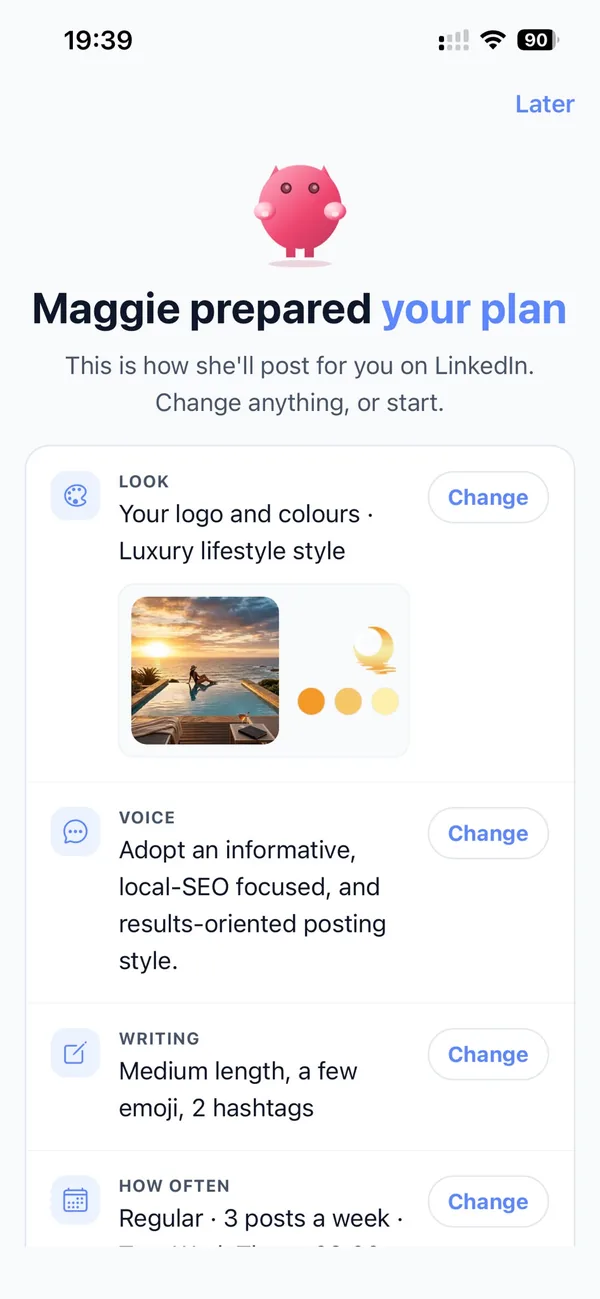
Posts for the company page and in the voice of your founders or CTO, on what you're building and why. Each channel gets its own voice, post template and posting times.
LinkedInSteady between launches
Topics are planned weeks ahead around releases, conferences and the questions your sales team hears most, so the blog and LinkedIn never go quiet between big moments.
Content calendarA brand profile your whole team can check
Enter your website and Maggie builds your brand profile: products, buyers, what sets you apart, SWOT, competitors and voice. Every post and picture starts from it.
Brand profileKnow what AI answers say about you
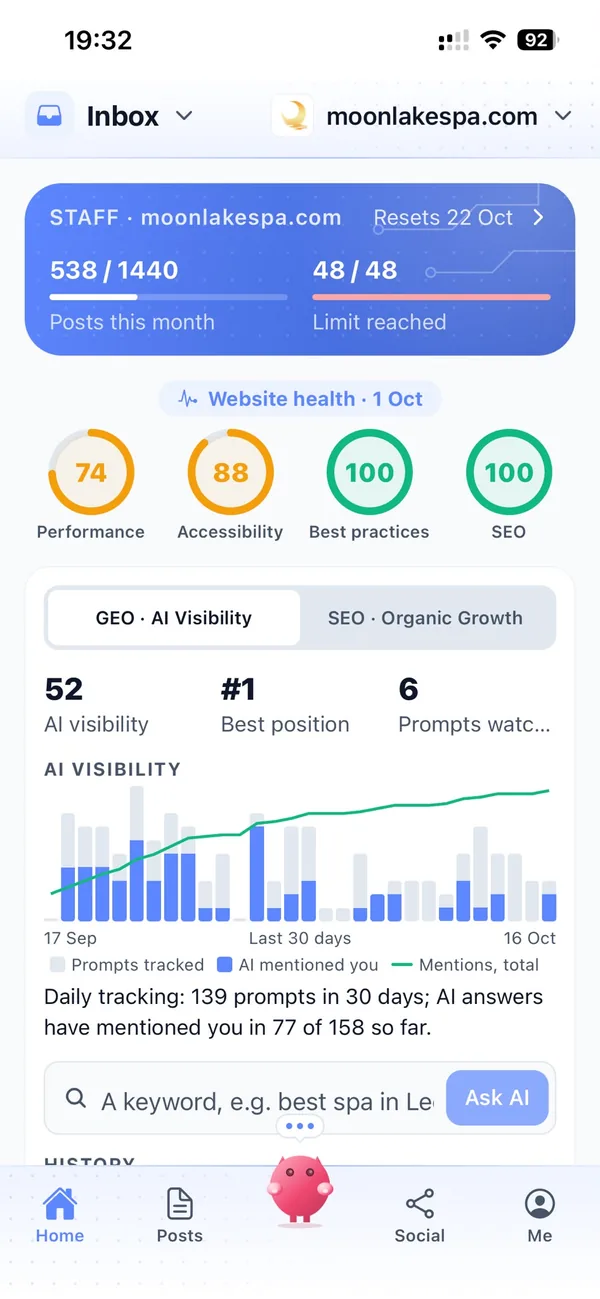
AI visibility shows how Google's AI answers describe and mention your company, and Search Console in cmo.so shows which articles bring people to your site.
AI visibilityApprovals that fit your sign-off process
By default nothing goes out until it's approved. Add product marketing, sales and leadership in Me → Team with presets such as editor or manager, and keep approvals on for every channel.
Approvals and teamYour marketing team, in your pocket
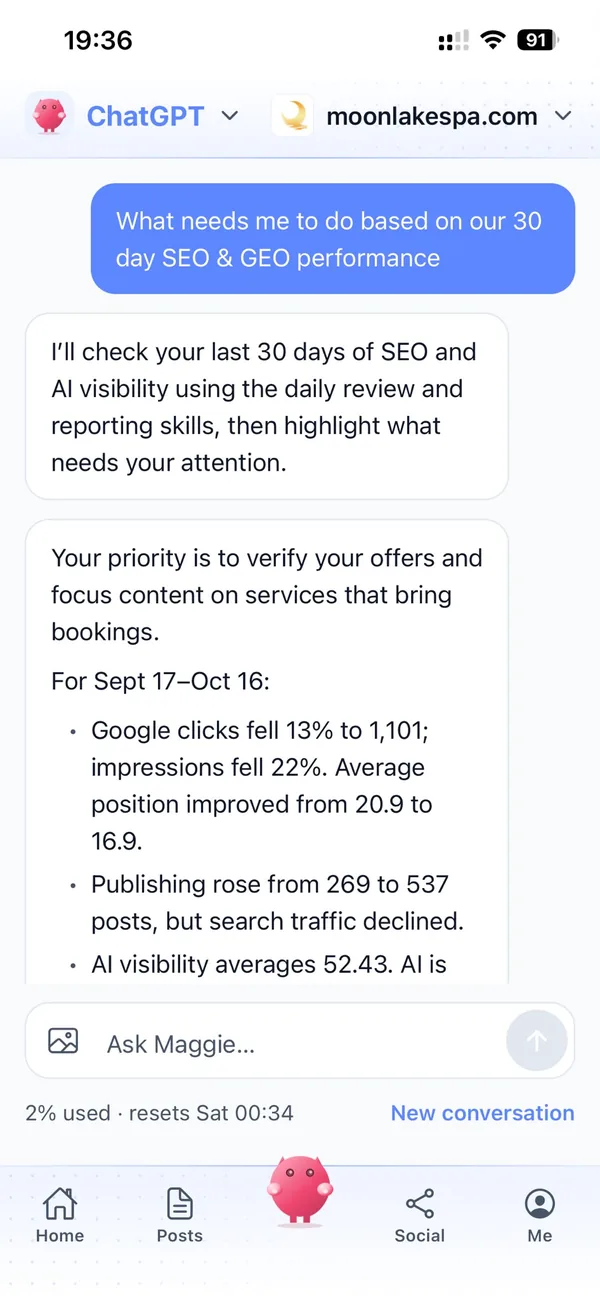
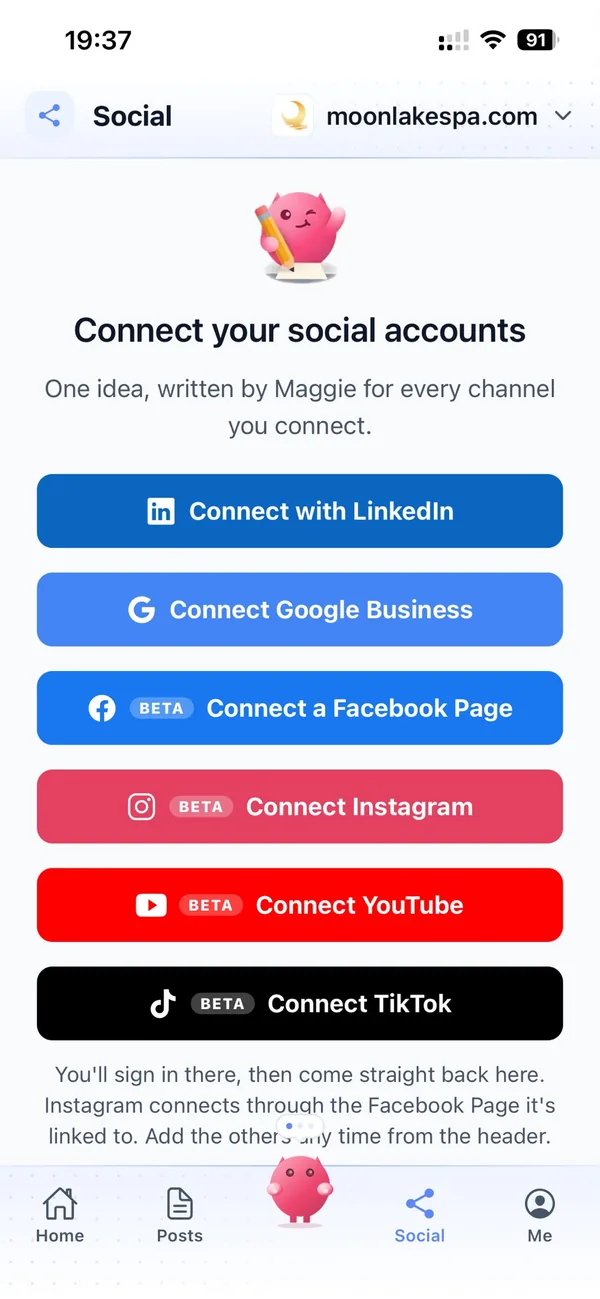
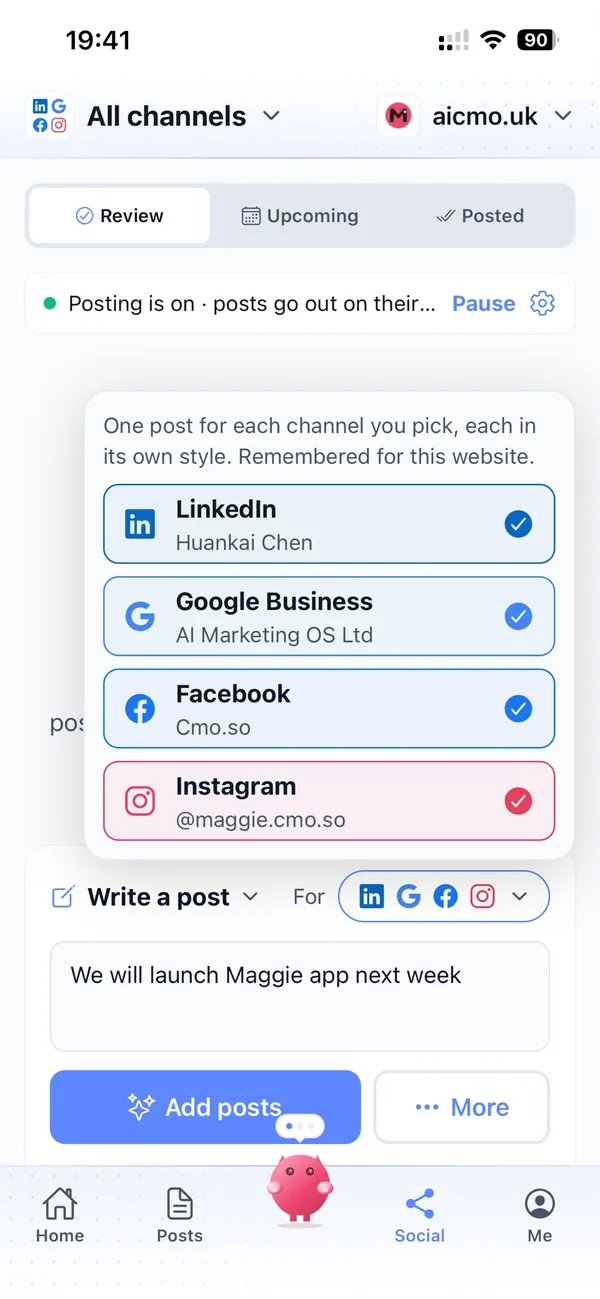
Real screens from the cmo.so app on iPhone.
From your website to a quarter of content in four steps
Enter your website
Maggie reads it and drafts your company's brand profile in minutes.
Check your profile
Correct your products and buyers, name the competitors you meet most and choose your channels.
Review the drafts
Your first week of posts arrives with pictures. Approve, edit or skip each one.
Publish on schedule
Approved posts go out at each channel's times and every one comes back with its link.
Why not just…
The usual ways enterprise software teams try to keep content flowing, and where each one runs out.
…hire another content marketer?
A full-time marketing hire in the UK costs around £3,000 a month before tools, and they still need weeks to learn your platform. Maggie starts from your website and has drafts ready in days.
…use a B2B content agency?
SEO and content agencies often cost around £1,000 a month, and every article goes through rounds of briefing and correction. Maggie keeps your brand profile and learns from each edit.
…let product marketing write between launches?
Launches, sales enablement and RFP support always come first, so the blog waits. Maggie keeps the everyday posts going so your team can focus on the big moments.
…write it with ChatGPT?
You still brief it, check it, make the picture and publish it yourself, and it doesn't know your buyers or competitors. Maggie remembers your company and posts on schedule.
Cut the £5,900/mo marketing bill to £15/mo
Everything a marketing team does, done by Maggie.
| What needs doing | Without cmo.so | With cmo.so |
|---|---|---|
| Full-time marketing hire | £3,000/mo | Included |
| SEO and AI search (GEO) agency | £1,000/mo | Included |
| Content writer, AI-assisted | £500/mo | Included |
| Social media manager, freelance | £800/mo | Included |
| Designed pictures for every post | £300/mo | Included |
| SEO and GEO softwareRank tracking, site audits, AI visibility | £250/mo | Included |
| AI writing and image tools | £50/mo | Included |
| Working hours | Office hours | 24/7 |
| Total per month | £5,900+ | From £15/mo |
Typical UK costs for a small business in 2026, with AI already cutting freelance rates. Estimates only; your own quotes will vary.
- 5 social posts, 30 once verified
- 15 Maggie messages a day
- Upgrade any time
- 12 posts a day
- 150 Maggie messages a day
- All channels
- 96 posts a day
- 1,000 Maggie messages a day
- All channels
Per website, billed monthly. Blog and social posts share one allowance; your best plan sets how much you can talk to Maggie across all your websites.
Marketing automation for enterprise software companies: your questions
Still unsure?
What is marketing automation for enterprise software companies?
It's software that does the repeating work of content marketing for an enterprise software business: planning topics, writing blog and LinkedIn posts for each kind of buyer, making pictures and publishing on schedule.
With cmo.so, Maggie does all of it from your company's website, and nothing goes out until your team approves it.
How do enterprise software companies get more customers online?
Enterprise software companies get more customers online by answering the questions each member of a buying committee asks, clearly and regularly, on their own website and LinkedIn, so they are already on the shortlist when a project starts.
Maggie writes those articles and posts every week, and Search Console in cmo.so shows which ones bring prospects to your site. Your sales team then has something useful to send at every stage of the deal.
How much does marketing automation cost for an enterprise software company?
There's a free plan with no card needed. Paid plans are per website and billed monthly: Air is £15 a month for two posts a day, and Pro at £45 a month suits a company posting on several channels. Max is £75 a month.
Founding members get lower prices for good on every plan until 1 January 2027. You can cancel any time, and published posts stay.
Which channels should enterprise software companies start with?
Most start with their own blog, for the detailed answers buyers search for, and LinkedIn, where decision makers and their advisers spend their working day.
YouTube is in beta and suits product walkthroughs you already have on video. Each channel has its own posting times, voice and queue.
Can cmo.so write for IT, finance and operations buyers at once?
It can, because one idea can become several posts in different styles. Maggie, your AI CMO, can turn a release into a technical explainer for IT, a business case angle for finance and an outcome-led LinkedIn post for operations leaders.
Your brand profile lists the roles on your typical buying committee, and you can add or correct them at any time.
Can the posts sound like our CTO or founder?
They can. You can set a voice for each channel, so LinkedIn posts can be written from a named person's point of view while the blog keeps your company voice.
Every post is approved before it goes out, and Maggie learns from the edits you make, so the voice gets closer each time.
How does it handle technical accuracy?
It starts from what your website says about your product, and your team checks every draft. Maggie writes from your brand profile, so if a module, integration or deployment option changes, update the profile and new posts follow it.
Approvals stay on by default, so a solutions engineer can read a technical post before it is published.
Do we need to share customer data or product documentation?
No, you don't need to share any customer data. Maggie works from your public website and the brand profile you check, so there is nothing to upload from your CRM or support system.
cmo.so never sells or rents your data, and Search Console data is only used to show your own results and plan your content, never for advertising or to train AI models.
Will cmo.so write case studies about our customers?
It won't make up customers or results. Maggie writes from what is on your website and in your brand profile, so if you have published a customer story, she can write posts that point readers to it.
You can add details you're happy to share, and every post is approved by your team before it goes out.
Does it help us show up in AI answers?
It helps, because posts are written to give clear, quotable answers that both Google and AI tools can use. AI visibility in cmo.so shows how Google's AI answers describe and mention your company.
No one can promise a place in AI answers or rankings, but regular, specific answers to buyers' questions give you a better chance of being part of them.
Is it safe to let AI post for an enterprise brand?
Yes, as long as your team keeps approving what goes out. Approvals are on by default for every channel, and you can keep them on permanently or let a channel you trust run on autopilot.
Social channels connect through each platform's official sign-in, so cmo.so never sees your passwords.
We run several product brands. Can cmo.so handle them all?
Yes. If each product has its own website, add them all to one account and each gets its own brand profile, channels, schedule and approvals.
Your team can switch between them, and people can be given access to only the brands they work on.
Keep every buyer reading between your sales calls
Enter your website. Your brand profile and first week of posts are ready in minutes, and nothing goes out until your team approves it.
- Free plan, no card needed
- You approve every post
- Cancel any time