

Marketing automation for blockchain and Web3 companies
Your community hears about every release within minutes. Developers, partners and businesses searching for what you do often hear nothing. Maggie, your AI CMO, turns your releases, integrations and know-how into plain explainers for your website and LinkedIn, and nothing goes out until your team approves it.
Free to start · No credit card · 30 free posts
Used by 600+ users and trusted by teams at
aeglesriphal.com
moonlakespa.com
shop.theteagroup.com
clo100.com
logtrics.io
mymorez.com
nextidal.com
otisapp.com
storaitelling.com
theheatpumps.co.uk
web-translations.com
exposeai.tech
orielipo.com
whitelabelcrowd.fund
elliptic.co
med.moonlakespa.com
netdex.co.il
orawellness.uk
reenest.com
syngage.ai
thepenthouseliving.com
zengolf.studio
imaintain.uk
rebuildingsociety.com
aurasocial.world
goaimex.com
moneyparents.com
newgenrenewables.uk
osmosisai.co
saunders.ac
teeza.app
thursdayclub.com
Why blockchain and Web3 companies struggle to keep their marketing going
You ship fast, the space moves faster, and the marketing that would explain what you build to everyone outside your community never quite gets written.
The jargon wall
Your docs make sense to developers who already live onchain. The product manager at a payments firm or a game studio reading your homepage sees rollups, bridges and gas, and leaves.
All the effort goes into the feed
Community channels need feeding every hour, so updates live in threads and chat that are gone by next week. Your own website has the same three posts it launched with.
Scepticism comes first
After every collapse and scam in the headlines, serious buyers start from doubt. They want to see a team, an audit history and clear explanations, not slogans.
One wrong word is a real risk
A casual line about returns, yields or being “safe” can mislead people and attract the wrong kind of attention. So every post waits for a careful reviewer who's also shipping.

Your mainnet upgrade ships on Thursday, and the explainers are ready on Tuesday.
It's Monday. Your team is shipping a network upgrade on Thursday that makes transactions cheaper for the apps built on you. The announcement thread is drafted. The blog post that explains it to a business audience is not.
You paste your company's website into cmo.so. Maggie reads it and writes your brand profile: your infrastructure, the developers and companies building on it, what sets you apart from other networks, your competitors and your careful, technical but friendly voice. You turn on Content Policy Guard with financial rules and add two house rules: never mention token prices, and never call anything risk-free.
By Tuesday the drafts are waiting, each with a picture in your brand's look: a blog post explaining what the upgrade changes for teams building payments apps, a LinkedIn post from your CTO on why you prioritised it, and a LinkedIn post about a new wallet integration. Content Policy Guard has held one line that hinted at higher returns for holders, with a suggested rewrite. Your head of communications, added in Me → Team, edits one sentence and approves the rest.
The posts go out at the times you set and each comes back with its link, ready for your community team to share. Next week Maggie picks the next question developers and partners are searching for, and AI visibility shows how Google's AI answers describe your project.
Marketing that explains what you build, carefully
Each of those problems has an answer, and your team still approves everything that goes out under your name.
Explainers for people outside the bubble
Plain posts on what your network, wallet or tooling does, how it compares and what it's for, written for Google and for AI answers. Published to your WordPress, Webflow, Wix or Shopify site, or any site through the cmo.so API.
Blog on autopilotReleases that outlive the thread
Upgrades, integrations, audits and hackathon results become blog posts and LinkedIn posts that people can still find in six months, and your community team can link to.
Release postsChecked before anyone sees it
Turn on Content Policy Guard and posts are checked against financial rules and your own house rules. A risky post is held as a draft with a suggested rewrite. These are AI suggestions, not legal or compliance advice.
Content Policy GuardYour voice, not crypto hype
Enter your website and Maggie builds your brand profile: what you build, who builds on it, what sets you apart, competitors and voice. Every post and picture starts from it.
Brand profileLinkedIn for partners and enterprise buyers
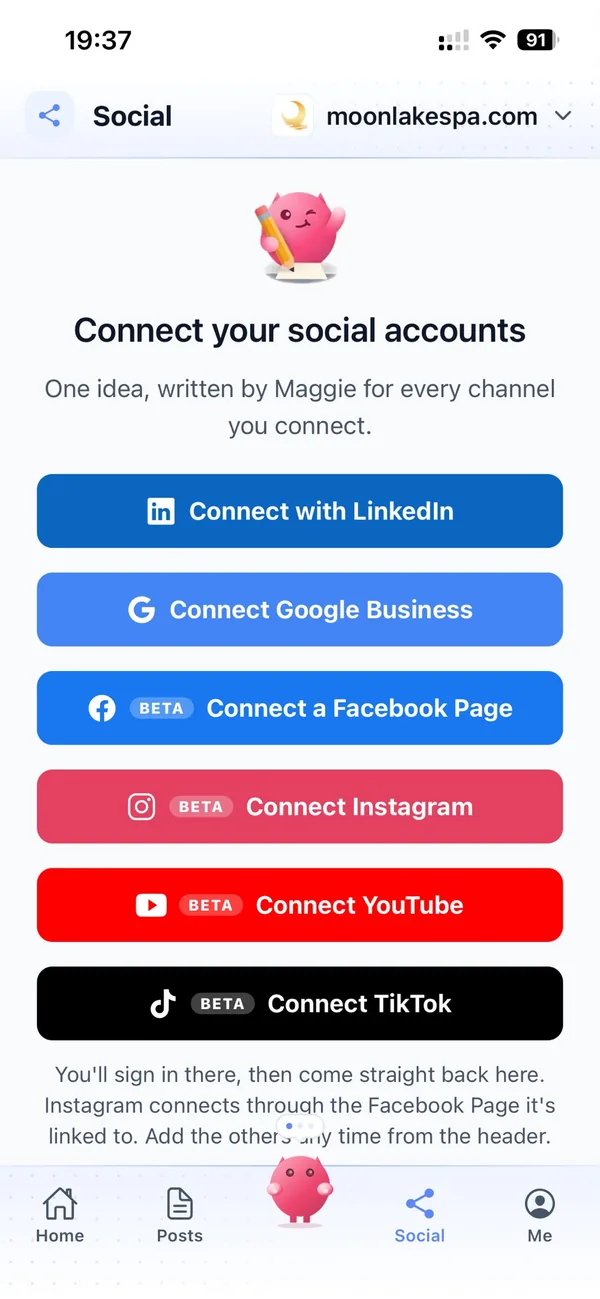
One idea becomes a post for each channel in its own style: LinkedIn for partners, investors and enterprise teams, YouTube in beta for walkthroughs, and your own blog as the reference.
Every channelYour team has the final word
By default nothing goes out until it's approved. Add engineers, communications and legal reviewers in Me → Team, keep approvals on for every channel and see who approved what.
ApprovalsYour marketing team, in your pocket
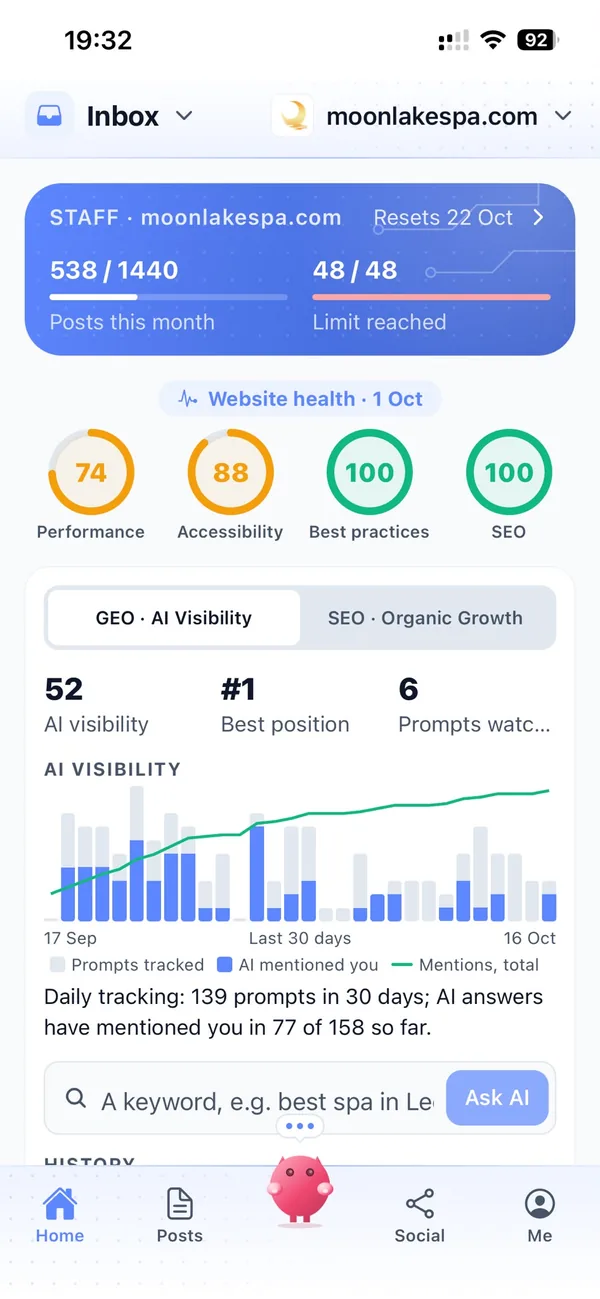
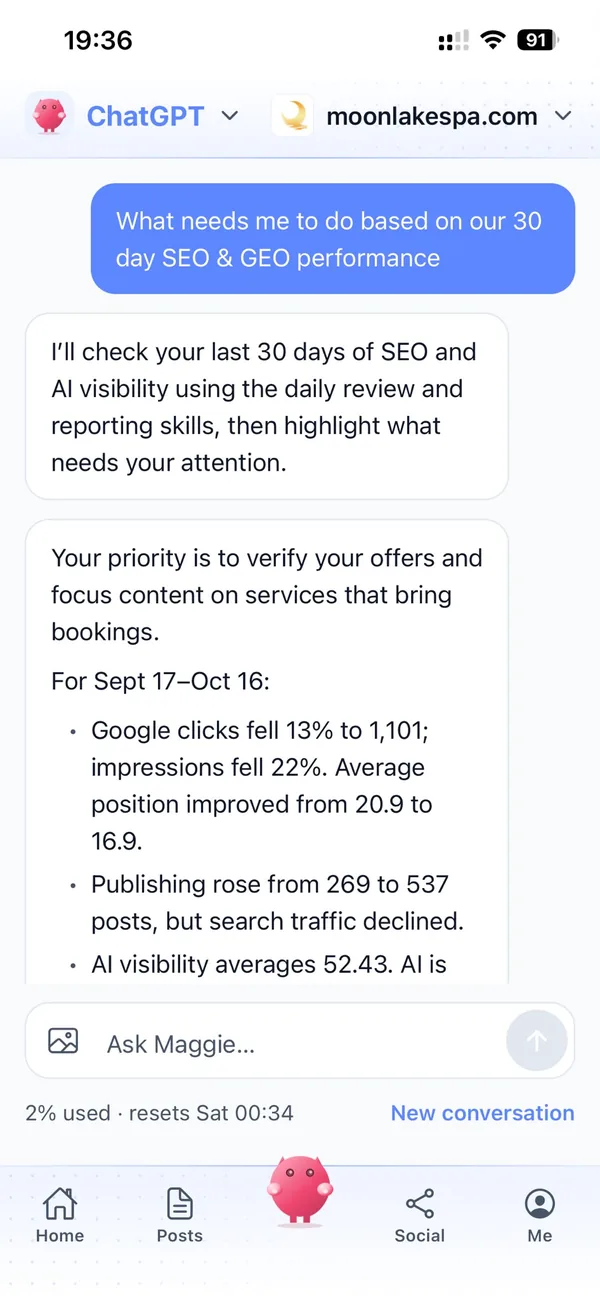
Real screens from the cmo.so app on iPhone.
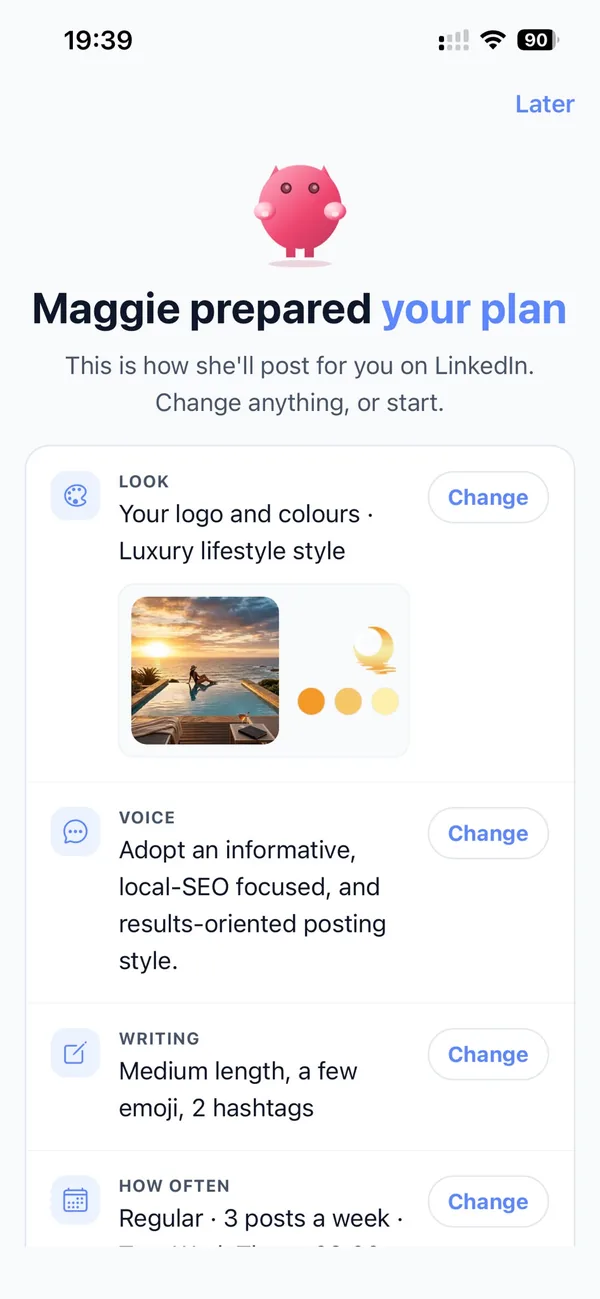
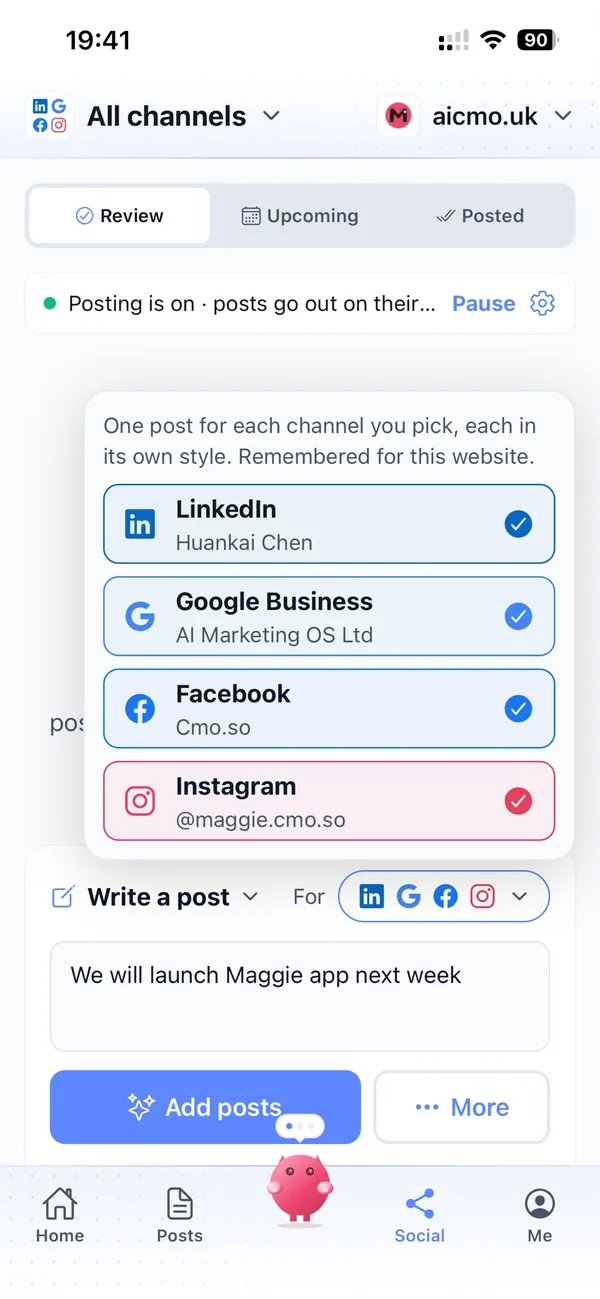
From your website to careful, regular posts in four steps
Enter your website
Maggie reads it and drafts your company's brand profile in minutes.
Set your rules
Correct the profile, turn on Content Policy Guard with financial rules and add your own, such as never mentioning token prices.
Review every draft
Your first week of posts arrives with pictures. Your team approves, edits or skips each one.
Let them go out
Approved posts go out at each channel's times and every one comes back with its link.
Why not just…
The usual ways Web3 teams try to get the word out, and where each one runs out.
…post it all in community channels?
Community chat and threads reach people who already follow you, and they scroll away within days. Posts on your own website and LinkedIn reach businesses and developers who are searching, and stay findable.
…hire a crypto marketing agency?
Some promise reach that's hard to check, and SEO and content agencies often cost around £1,000 a month. Maggie writes and publishes every week from £15 a month, and you approve every word.
…get the developers to write it?
They know it best, and they're also shipping. Maggie drafts from your docs and release notes, so a developer only needs to check the facts, not write from a blank page.
…write it with ChatGPT?
You still brief it, check it, make the picture and post it yourself, and it doesn't remember your house rules. Maggie keeps your brand profile and rules, and publishes on schedule.
Cut the £5,900/mo marketing bill to £15/mo
Everything a marketing team does, done by Maggie.
| What needs doing | Without cmo.so | With cmo.so |
|---|---|---|
| Full-time marketing hire | £3,000/mo | Included |
| SEO and AI search (GEO) agency | £1,000/mo | Included |
| Content writer, AI-assisted | £500/mo | Included |
| Social media manager, freelance | £800/mo | Included |
| Designed pictures for every post | £300/mo | Included |
| SEO and GEO softwareRank tracking, site audits, AI visibility | £250/mo | Included |
| AI writing and image tools | £50/mo | Included |
| Working hours | Office hours | 24/7 |
| Total per month | £5,900+ | From £15/mo |
Typical UK costs for a small business in 2026, with AI already cutting freelance rates. Estimates only; your own quotes will vary.
- 5 social posts, 30 once verified
- 15 Maggie messages a day
- Upgrade any time
- 12 posts a day
- 150 Maggie messages a day
- All channels
- 96 posts a day
- 1,000 Maggie messages a day
- All channels
Per website, billed monthly. Blog and social posts share one allowance; your best plan sets how much you can talk to Maggie across all your websites.
Marketing automation for blockchain and Web3 companies: your questions
Still unsure?
What is marketing automation for blockchain and Web3 companies?
It's software that does the repeating work of marketing a Web3 company: planning topics, writing blog and social posts, making pictures and publishing them on schedule.
With cmo.so, Maggie does all of it from your company's website, checks posts against financial rules if you turn on Content Policy Guard, and nothing goes out until a person on your team approves it.
How do blockchain and Web3 companies get more customers online?
Blockchain and Web3 companies get more customers online by explaining clearly, outside their own community, what they build and who it's for: plain guides on their website, release posts that stay findable and regular LinkedIn posts for partners and businesses.
Maggie writes those posts every week from your website and release notes, Search Console in cmo.so shows which ones bring people to your site, and AI visibility shows how Google's AI answers describe you.
How much does it cost for a Web3 company?
There's a free plan with no card needed. Paid plans are per website and billed monthly: Air at £15 a month covers two posts a day, and Pro at £45 a month suits a team posting on several channels.
Founding members get lower prices for good on every plan until 1 January 2027. You can cancel any time.
Which channels should blockchain and Web3 companies start with?
Most start with their own blog and LinkedIn, because that's where partners, enterprise buyers and investors look for a company they can take seriously.
YouTube is in beta and suits walkthroughs and demos. cmo.so doesn't post to X, Discord or Telegram, so your community team keeps those, with blog posts to link to.
Is it safe to use AI for marketing in crypto and Web3?
It's safe when a qualified person reviews every post before it's published. cmo.so keeps approvals on by default, and Content Policy Guard can hold a post that may break financial rules as a draft with a suggested rewrite.
Content Policy Guard gives AI suggestions, not legal or compliance advice. It doesn't make a post compliant on its own, a qualified person should still review it, and your company stays responsible for what it publishes.
Will it write about token prices or returns?
Not if you tell it not to. You can add house rules to Content Policy Guard, such as never mentioning token prices, returns or yields, and a post that may break them is held as a draft with a suggested rewrite.
Your team still reads every post before approving it, because only a person can judge how a sentence will read to your community and to regulators.
Can it explain technical topics without dumbing them down?
Yes. Your brand profile says who you're writing for, so a post for developers can talk about architecture while a post for a business audience explains what it means for them.
Your engineers can correct any detail before approving, and Maggie learns from their edits, so the explanations get more accurate each week.
Does it post to X, Discord or Telegram?
No, it doesn't. cmo.so publishes to your website, LinkedIn and Google Business, with Facebook, Instagram, YouTube and TikTok in beta.
Many Web3 teams use it to write the blog post that every community announcement can point to, so the detail lives on a page you own.
Can cmo.so turn our release notes into posts?
Yes. Give it the notes for an upgrade, integration or audit, and Maggie writes a blog post and LinkedIn posts that explain what changed and why it matters.
You choose what's ready to announce and when, and nothing goes out before you approve it, so nothing leaks ahead of a launch.
We run several projects. Can they each have their own voice?
Yes. Add each project's website to one account and each gets its own brand profile, channels, schedule and approvals.
That suits a studio or foundation with several products, or a protocol with a separate developer site.
Which websites does it work with?
cmo.so publishes to WordPress (including WooCommerce), Shopify, Wix and Webflow, and to any other website through the cmo.so API, which suits custom-built sites.
Each post is reported back with its link once it is live.
Can our legal or compliance reviewer approve posts?
Yes. Add them in Me → Team, using presets such as editor or manager or choosing each area yourself, and keep approvals on for every channel.
Each post shows who approved it, and you can pause a channel at any time, for example during a security incident.
Explain what you build to everyone who isn't in your Discord yet
Enter your website. Your brand profile and first week of posts are ready in minutes, and nothing goes out until your team approves it.
- Free plan, no card needed
- You approve every post
- Cancel any time