

Marketing automation for ad tech companies
You help other businesses get their message seen, yet your own blog and LinkedIn go quiet between conferences. Maggie, your AI CMO, writes explainers, product updates and opinion posts for the agencies, brands and publishers you sell to, and you approve every one.
Free to start · No credit card · 30 free posts
Used by 600+ users and trusted by teams at
aeglesriphal.com
moonlakespa.com
shop.theteagroup.com
clo100.com
logtrics.io
mymorez.com
nextidal.com
otisapp.com
storaitelling.com
theheatpumps.co.uk
web-translations.com
exposeai.tech
orielipo.com
whitelabelcrowd.fund
elliptic.co
med.moonlakespa.com
netdex.co.il
orawellness.uk
reenest.com
syngage.ai
thepenthouseliving.com
zengolf.studio
imaintain.uk
rebuildingsociety.com
aurasocial.world
goaimex.com
moneyparents.com
newgenrenewables.uk
osmosisai.co
saunders.ac
teeza.app
thursdayclub.com
Why ad tech companies struggle to keep their marketing going
The industry changes every quarter, your buyers are sceptical and your best explainers live in sales decks.
Conference spikes, then silence
Your team posts hard in the weeks around the big industry events, then goes back to building and selling. Buyers who meet you at a stand find a blog that hasn't moved since the last show.
Hard products to explain
Contextual targeting, clean rooms, supply path optimisation, attention metrics. Buyers search for plain explanations, and if yours aren't there, a competitor's or a trade article defines the category for you.
Every change needs a point of view
Privacy changes, browser updates and new measurement standards land constantly, and agencies want to know what they mean. Taking weeks to publish your view makes you look behind.
Sceptical buyers, crowded feeds
Media buyers and publisher teams see a lot of bold claims. Steady, specific and honest content is what earns attention, and it's exactly what a small marketing team can't keep up.

A browser update dropped on Monday, and your point of view is out by Wednesday.
It's Monday. A browser has announced another change to how tracking works, three agency clients have already emailed asking what it means, and your one marketer is preparing the stand for next month's conference.
You paste your company's website into cmo.so. Maggie reads it and writes your brand profile: your contextual advertising platform, the agency trading desks, brands and publishers you work with, your privacy-first approach, your competitors and your direct, slightly dry voice. You correct one thing: you sell to publishers as well as buyers now.
By Tuesday the drafts are waiting, each with a picture in your company's look: a blog explainer on what the browser change means for targeting and measurement, a LinkedIn post from your CEO with your view on it, a post for publishers about keeping their inventory valuable, and a short post inviting buyers to book a meeting at the conference. You approve three and make the CEO's post a little sharper.
The posts go out at the times you set for each channel and each comes back with its link. While your team builds the next release, Maggie is already planning a glossary series for new buyers, and Search Console in cmo.so shows which explainers agencies are finding.
A marketing assistant who keeps up with the industry
Each of those problems has an answer, and you still decide what goes out under your company's name.
Explainers that define your category
Plain-English articles on how your technology works and what buyers should ask, written for Google and for AI answers. Published to your WordPress, Webflow, Wix or Shopify site, or any site through the cmo.so API.
Blog on autopilotOpinion posts on LinkedIn
Posts in your founders' and leaders' voices on privacy changes, measurement and where the market is going, written for agency, brand and publisher teams.
LinkedInSteady between the big events
Topics are planned weeks ahead and queued, so your channels keep going between conferences, and event posts are ready before the show instead of after it.
Content calendarYour product, not industry buzzwords
Enter your website and Maggie builds your brand profile: your products, who buys them, what sets you apart, competitors and voice. Every post and picture starts from it.
Brand profileSeen in AI answers
When a buyer asks an AI assistant how a type of ad technology works, clear and quotable explainers help your company get mentioned. AI visibility shows how Google's AI answers describe you.
AI visibilityOne release, every channel
One product update becomes a blog post, a LinkedIn post for buyers and another for publishers, and a YouTube post for your demo video (in beta), each in its channel's style.
Every channelYour marketing team, in your pocket
Real screens from the cmo.so app on iPhone.
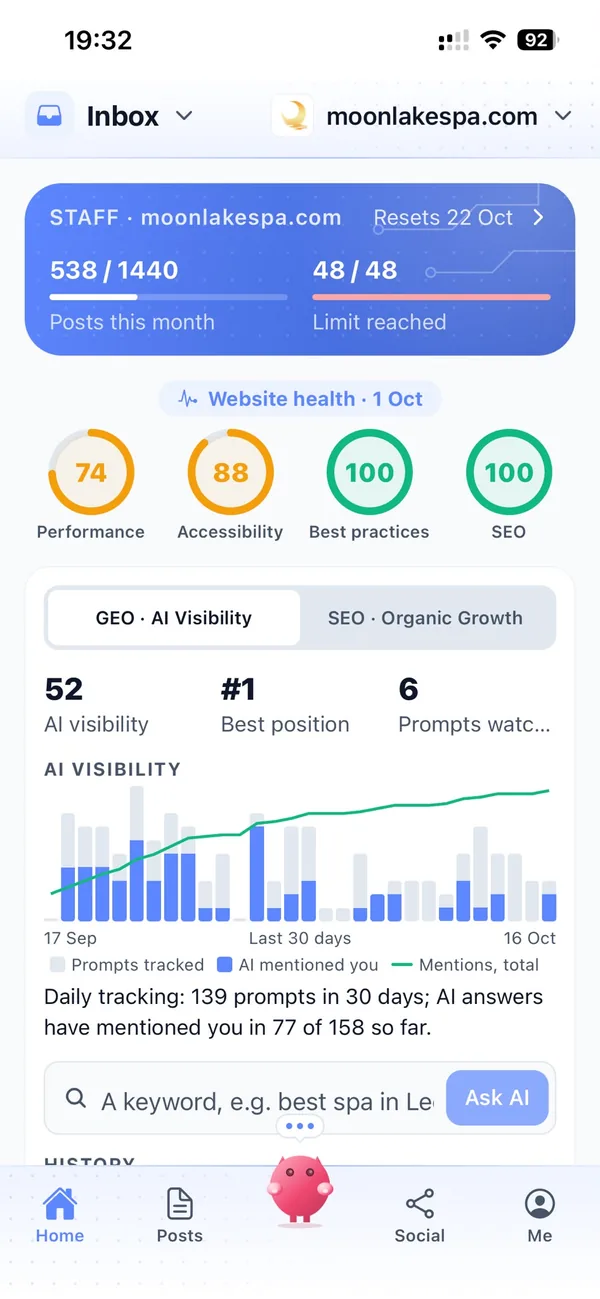
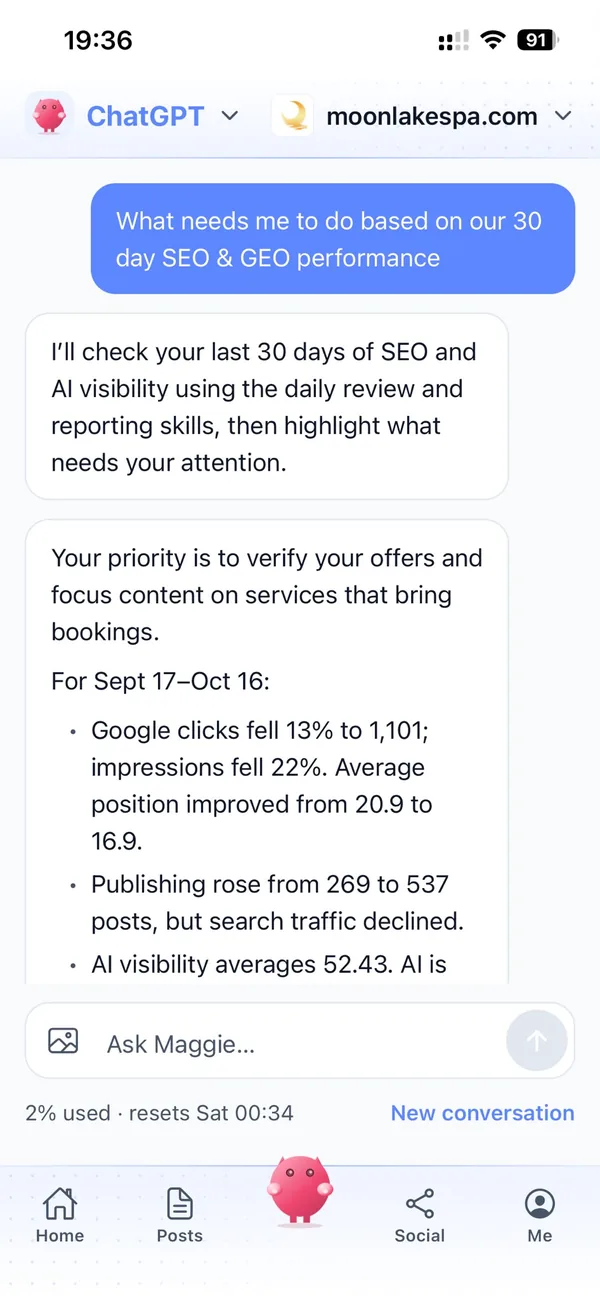
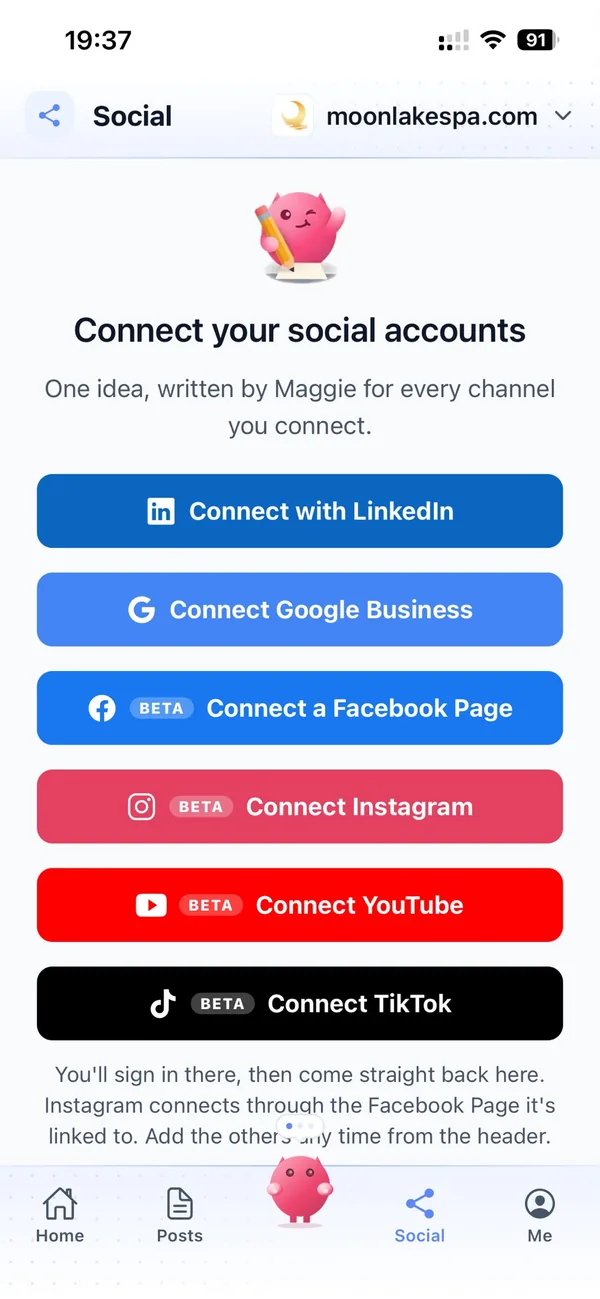
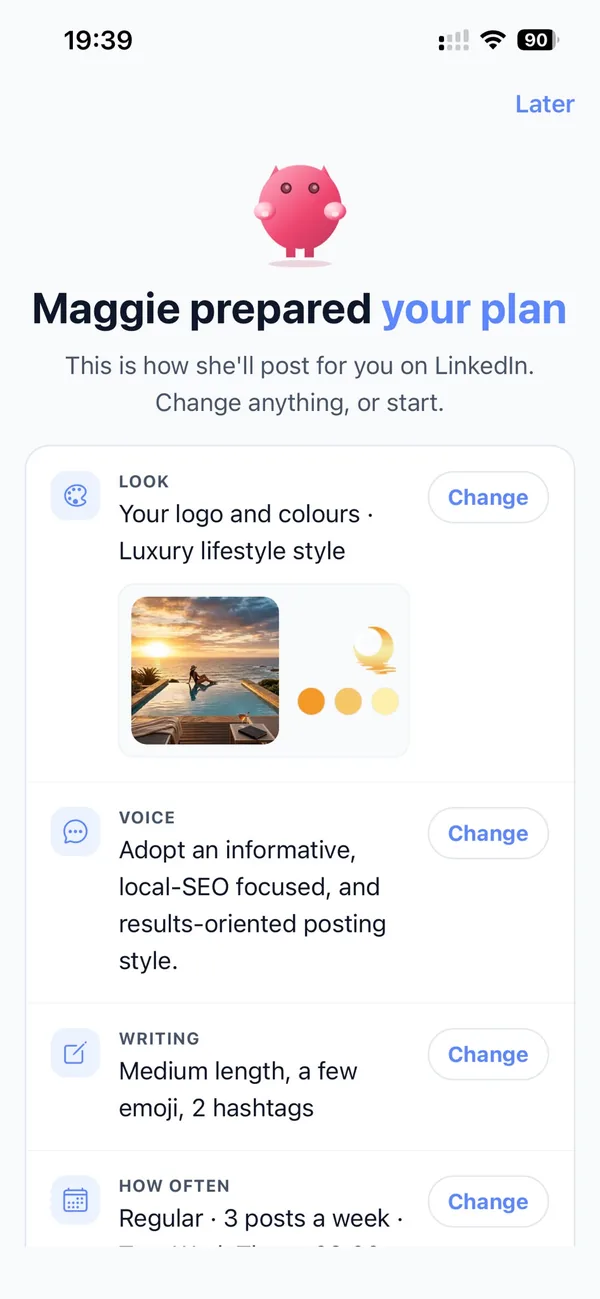
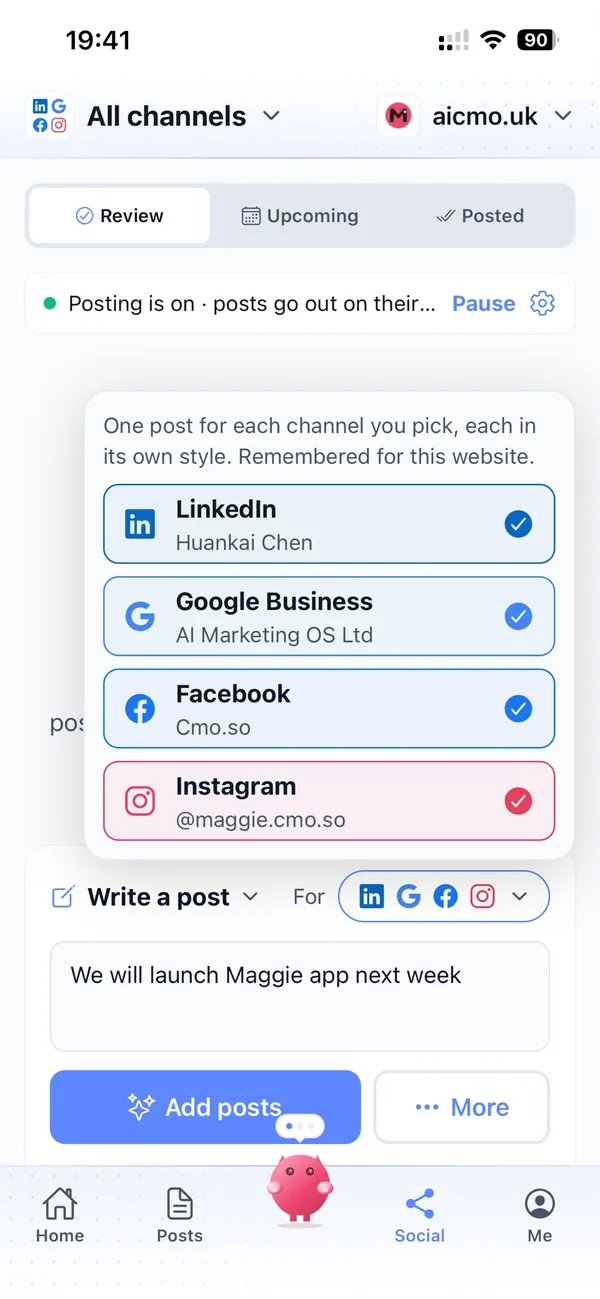
From your company's website to a steady flow of thought leadership in four steps
Enter your website
Maggie reads it and drafts your company's brand profile in minutes.
Check your profile
Correct your products and who you sell to, add the topics you want to own and choose your channels.
Review the drafts
Your first week of posts arrives with pictures. Approve, edit or skip each one.
Let them go out
Approved posts go out at each channel's times and every one comes back with its link.
Why not just…
The usual ways ad tech companies try to stay visible, and where each one runs out.
…rely on conferences and sponsorships?
Events put you in front of buyers for a few days, at a high price. Maggie keeps your ideas in front of them every week in between.
…hire a PR or content agency?
PR and content agencies often cost around £1,000 a month or more, and still need your experts to brief them. Maggie writes and publishes every week from £15 a month, starting from your own website.
…let the sales team post on LinkedIn?
Some will, most won't, and the posts rarely line up with your positioning. Maggie writes consistent posts from one brand profile that anyone on the team can approve and share.
…write it with ChatGPT?
You still brief it, check it, make the picture and post it yourself, and it doesn't know your product or your view of the market. Maggie remembers your company and puts posts out on schedule.
Cut the £5,900/mo marketing bill to £15/mo
Everything a marketing team does, done by Maggie.
| What needs doing | Without cmo.so | With cmo.so |
|---|---|---|
| Full-time marketing hire | £3,000/mo | Included |
| SEO and AI search (GEO) agency | £1,000/mo | Included |
| Content writer, AI-assisted | £500/mo | Included |
| Social media manager, freelance | £800/mo | Included |
| Designed pictures for every post | £300/mo | Included |
| SEO and GEO softwareRank tracking, site audits, AI visibility | £250/mo | Included |
| AI writing and image tools | £50/mo | Included |
| Working hours | Office hours | 24/7 |
| Total per month | £5,900+ | From £15/mo |
Typical UK costs for a small business in 2026, with AI already cutting freelance rates. Estimates only; your own quotes will vary.
- 5 social posts, 30 once verified
- 15 Maggie messages a day
- Upgrade any time
- 12 posts a day
- 150 Maggie messages a day
- All channels
- 96 posts a day
- 1,000 Maggie messages a day
- All channels
Per website, billed monthly. Blog and social posts share one allowance; your best plan sets how much you can talk to Maggie across all your websites.
Marketing automation for ad tech companies: your questions
Still unsure?
What is marketing automation for ad tech companies?
It's software that does the repeating work of marketing an ad tech business: planning topics, writing explainers, product updates and LinkedIn posts, making pictures and publishing them on schedule.
With cmo.so, Maggie does all of it from your company's website, and nothing goes out until you approve it.
How do ad tech companies get more customers online?
Ad tech companies get more customers online by explaining what they do clearly, sharing a credible view on industry changes and staying visible to agencies, brands and publishers between deals and events.
Maggie writes explainers and LinkedIn posts every week, and Search Console shows which topics bring buyers to your website.
How much does marketing automation cost for an ad tech company?
There's a free plan with no card needed. Paid plans are per website and billed monthly: Air at £15 a month covers two posts a day, and Pro at £45 a month suits a company posting on several channels.
Max at £75 a month gives more room as you grow. Founding members get lower prices for good on every plan until 1 January 2027, and you can cancel any time.
Which channels should ad tech companies start with?
Most ad tech companies start with LinkedIn, because that's where agency, brand and publisher teams follow the industry, plus their own blog for explainers that rank and get quoted.
YouTube (in beta) suits demo and talk videos, and Google Business helps when people look you up by name. Each channel has its own posting times and queue.
Does cmo.so run our ad campaigns too?
It doesn't run ads or manage ad budgets. Maggie plans, writes and publishes content for your website and social channels.
That makes her a good fit for the content side of your own marketing, alongside whatever paid media you run.
Can it write about technical topics accurately?
It writes from your website and the brand profile you check, so it uses your descriptions of your product and how it works.
You review every post before it goes out, and Maggie learns from your edits, so technical posts get closer to how your team explains things.
Can posts react to industry news quickly?
Posts can be planned around news you know is coming, and you can ask for a post on a new change at any time and approve it as soon as it's ready.
Most of the steady value comes from explainers and opinion posts that stay useful long after the news.
Will it make claims about performance or results?
It never invents results, statistics or client names. Posts describe what your product does from your website and your brand profile.
If you want to quote a result, add it yourself when you review the post.
Can cmo.so write for buyers and publishers separately?
It can, and each audience gets its own topics. Maggie plans posts for agencies and brands, and separate posts for publisher and supply teams, from one brand profile.
You choose which channels and times suit each audience.
Is it safe to let AI post for our company?
Yes, because nothing goes out until you approve it. Approvals are on by default, and you can keep them on for every channel or let a channel you trust run on autopilot.
Social channels connect through each platform's official sign-in, so cmo.so never sees your passwords, and cmo.so never sells or rents your data.
Can our team approve posts too?
Yes. In Me → Team you can add people and choose what each can see or change, using presets such as editor or manager.
So your product marketer can approve technical posts while your CEO approves the ones in their name.
Stay in buyers' feeds between conferences
Enter your website. Your brand profile and first week of posts are ready in minutes, and nothing goes out until you approve it.
- Free plan, no card needed
- You approve every post
- Cancel any time