


Marketing automation for finance software companies
Finance teams, bookkeepers and business owners research software carefully, and they search with very specific questions. Maggie, your AI CMO, writes the explainers, comparisons and LinkedIn posts that answer them, checked against financial rules, and your team approves every one.
Free to start · No credit card · 30 free posts
Used by 600+ users and trusted by teams at
aeglesriphal.com
moonlakespa.com
shop.theteagroup.com
clo100.com
logtrics.io
mymorez.com
nextidal.com
otisapp.com
storaitelling.com
theheatpumps.co.uk
web-translations.com
exposeai.tech
orielipo.com
whitelabelcrowd.fund
elliptic.co
med.moonlakespa.com
netdex.co.il
orawellness.uk
reenest.com
syngage.ai
thepenthouseliving.com
zengolf.studio
imaintain.uk
rebuildingsociety.com
aurasocial.world
goaimex.com
moneyparents.com
newgenrenewables.uk
osmosisai.co
saunders.ac
teeza.app
thursdayclub.com
Why finance software companies struggle to keep their content going
The product team ships every fortnight. The content plan falls behind every fortnight too.
Buyers search for the job, not your name
Finance leads search for how to speed up month-end close, chase late invoices or forecast cash flow. If your articles don't answer those questions, the comparison sites and bigger platforms do.
Every claim needs care
Words about savings, accuracy, tax or getting paid faster can mislead if they're loose. Getting them right takes time from people who should be building or selling.
Features ship, nobody hears
A new bank feed, an approvals workflow, an integration your customers asked for. It goes into the release notes and stops there, instead of becoming posts that bring in the next customer.
Accountants are a channel you rarely talk to
Bookkeepers and accounting firms recommend software to their clients. They need regular, practical content to share, and a once-a-quarter newsletter isn't enough to stay front of mind.

Year-end is coming, and your explainers are already queued.
It's Monday at a 20-person company that makes invoicing and cash-flow software for small businesses. You've just shipped automatic payment reminders, the financial year-end rush is six weeks away, and the blog's last post is a product update from the spring.
You paste the company's website into cmo.so. Maggie reads it and writes your brand profile: your product, the small business owners, bookkeepers and finance managers who use it, the integrations you offer, the platforms you compete with and the clear, no-jargon way you explain money. You switch on Content Policy Guard for financial rules and add your own rule: never promise a customer will be paid faster by a specific amount.
By Tuesday the drafts are waiting, each with a picture in your brand's look: a blog post on a simple year-end checklist for small businesses, an honest comparison of ways to chase late invoices, a LinkedIn post from your founder about why you built payment reminders, and a post for bookkeepers on setting reminders up for their clients. Content Policy Guard holds one line that reads like a promise about cash flow and suggests a rewrite. Your head of product checks the feature details and approves three.
The posts go out at the times you set for each channel, and each comes back with its link. Next month, Search Console in cmo.so shows which explainers are found, and AI visibility shows whether Google's AI answers now mention your product when someone asks how to manage late payments.
A content team that understands finance buyers
Each of those problems has an answer, and your team still decides what goes out under your brand.
Explainers finance teams search for
Articles on month-end close, invoicing, cash-flow forecasting, approvals and year-end, plus honest comparisons with the tools you compete with, written for Google and for AI answers. Published to your WordPress, Webflow, Wix or Shopify site, or any site through the cmo.so API.
Blog on autopilotChecked against financial rules
Turn on Content Policy Guard and posts are checked against financial rules, or your company's own. A risky post is held as a draft with a suggested rewrite. These are AI suggestions, not legal or compliance advice.
Content Policy GuardEvery release, told well
New features, integrations and improvements become blog posts and LinkedIn updates that explain what they change for a finance team, not just what was shipped.
Product newsLinkedIn for buyers and partners
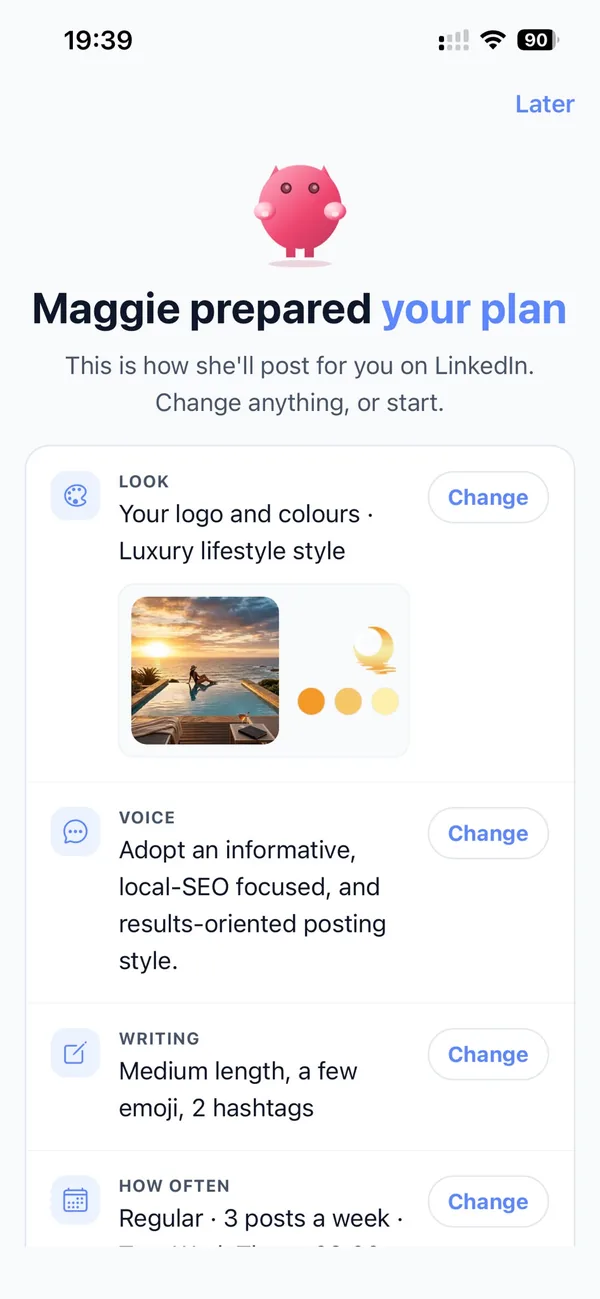
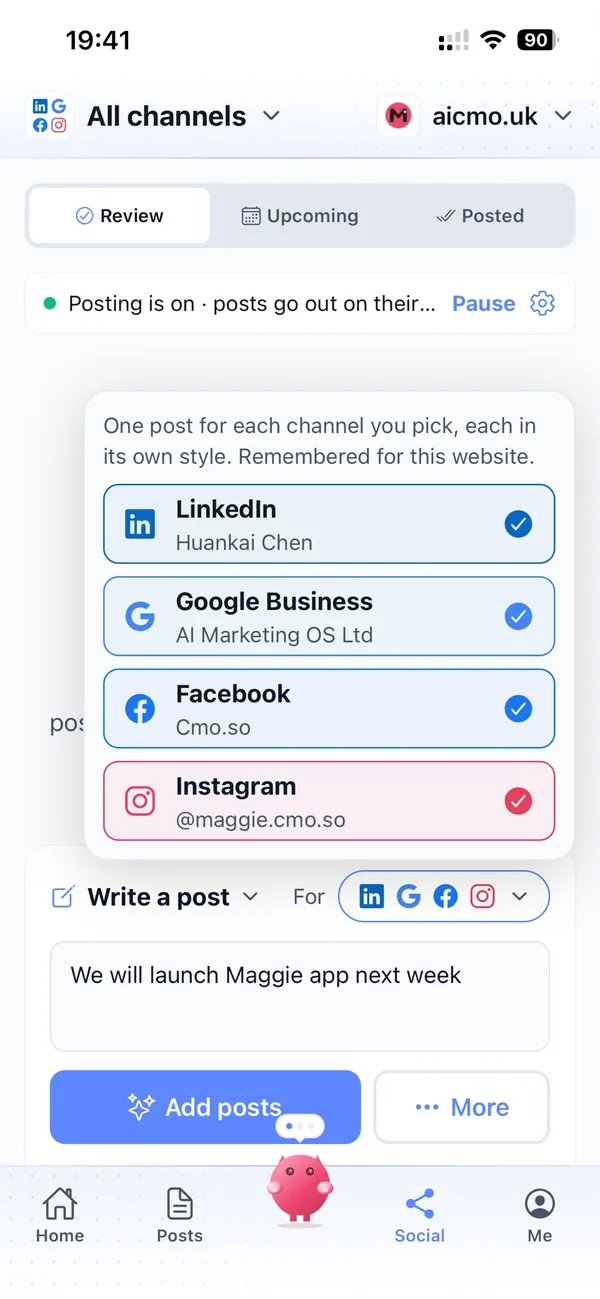
Posts in your brand's voice, or your founder's, for finance leads, business owners and the accountants and bookkeepers who recommend software, on the days and times you choose.
LinkedInSee what's found and quoted
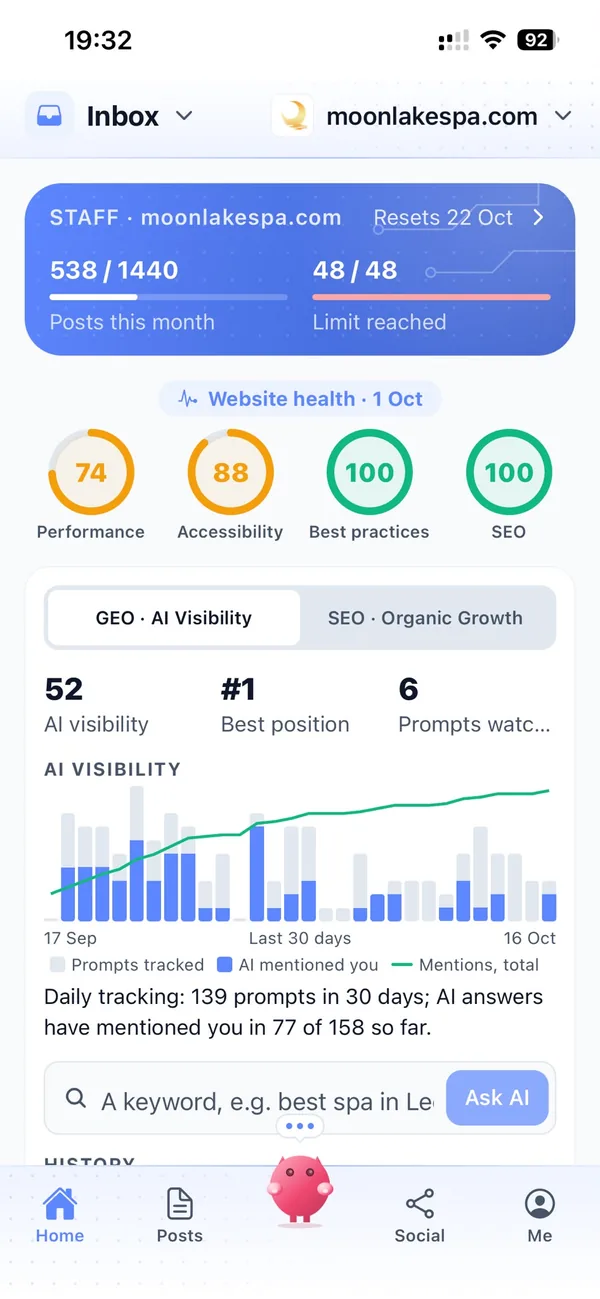
Search Console in cmo.so shows which posts bring people to your site, and AI visibility shows how Google's AI answers describe your product next to the alternatives.
Search Console and AI visibilityBuilt for software teams
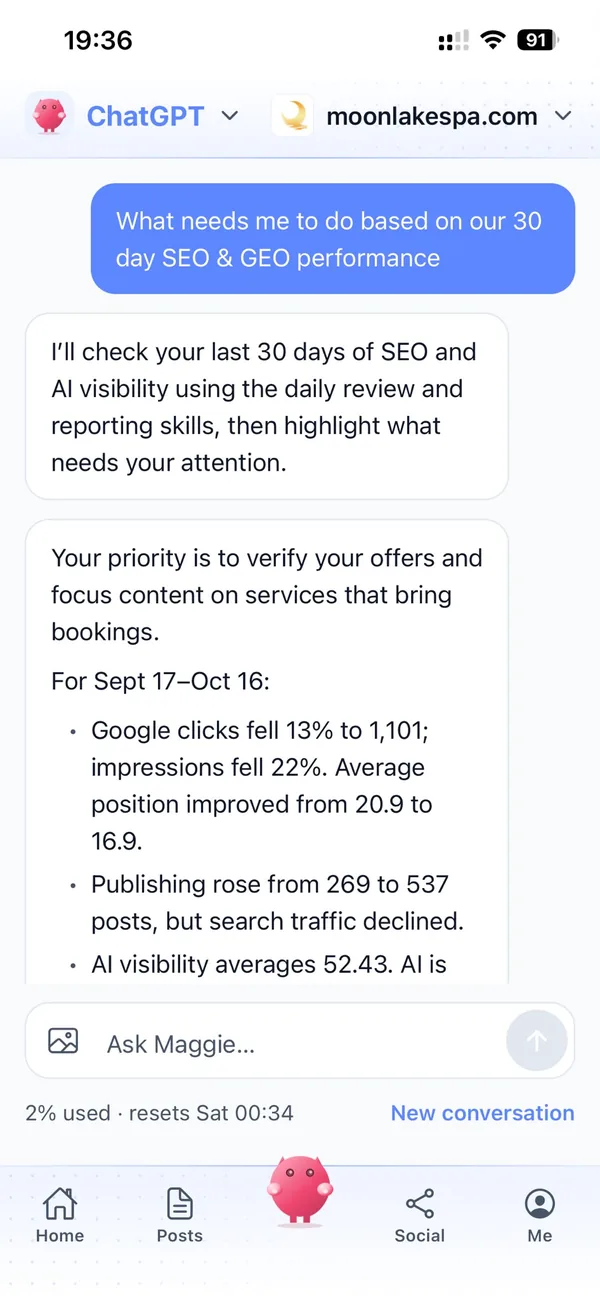
Add product, marketing and compliance people in Me → Team. Ask Maggie from ChatGPT or Claude through the cmo.so connector, or use the MCP server and CLI.
Team and toolsYour marketing team, in your pocket
Real screens from the cmo.so app on iPhone.

From your product site to a steady content plan in four steps
Enter your website
Maggie reads it and drafts your company's brand profile in minutes.
Check your profile
Correct your product and audiences, turn on Content Policy Guard, add your own rules and choose your channels.
Review the drafts
Your first week of posts arrives with pictures. Approve, edit or skip each one.
Let them go out
Approved posts go out at each channel's times and every one comes back with its link.
Why not just…
The usual ways finance software companies try to keep content going, and where each one runs out.
…hire a content marketer?
A full-time marketing hire in the UK costs around £3,000 a month before tools, and one person still struggles to cover the blog, LinkedIn and partner content. Maggie writes and publishes every week from £15 a month.
…use a fintech content agency?
SEO and content agencies often cost around £1,000 a month, with briefs, rounds of edits and a monthly report. Maggie works from your brand profile every week and you approve each post directly.
…rely on paid search and review sites?
They bring buyers who are already comparing, at a price per click or listing. Articles on your own site keep answering the earlier questions that lead people to you.
…write it with ChatGPT?
You still brief it, check it, find a picture and post it yourself, and it doesn't know your product, your customers or your rules. Maggie remembers your company and puts posts out on schedule.
Cut the £5,900/mo marketing bill to £15/mo
Everything a marketing team does, done by Maggie.
| What needs doing | Without cmo.so | With cmo.so |
|---|---|---|
| Full-time marketing hire | £3,000/mo | Included |
| SEO and AI search (GEO) agency | £1,000/mo | Included |
| Content writer, AI-assisted | £500/mo | Included |
| Social media manager, freelance | £800/mo | Included |
| Designed pictures for every post | £300/mo | Included |
| SEO and GEO softwareRank tracking, site audits, AI visibility | £250/mo | Included |
| AI writing and image tools | £50/mo | Included |
| Working hours | Office hours | 24/7 |
| Total per month | £5,900+ | From £15/mo |
Typical UK costs for a small business in 2026, with AI already cutting freelance rates. Estimates only; your own quotes will vary.
- 5 social posts, 30 once verified
- 15 Maggie messages a day
- Upgrade any time
- 12 posts a day
- 150 Maggie messages a day
- All channels
- 96 posts a day
- 1,000 Maggie messages a day
- All channels
Per website, billed monthly. Blog and social posts share one allowance; your best plan sets how much you can talk to Maggie across all your websites.
Marketing automation for finance software companies: your questions
Still unsure?
What is marketing automation for finance software companies?
It's software that does the repeating work of marketing a finance product: planning topics, writing explainers, comparisons and LinkedIn posts, making pictures and publishing them on schedule.
With cmo.so, Maggie does all of it from your website, and nothing goes out until someone on your team approves it.
How do finance software companies get more customers online?
Finance software companies get more customers online by answering the questions finance teams and business owners search for, clearly and often, on their own website and LinkedIn, and by showing honestly how they compare with the alternatives.
Maggie writes that content every week for the problems your product solves, and Search Console in cmo.so shows which posts bring people to your site.
Is it safe to use AI for financial content?
It is safe when a qualified person reviews every post before it is published. cmo.so keeps approvals on by default, and Content Policy Guard can hold a post that may break financial rules as a draft with a suggested rewrite.
Content Policy Guard gives AI suggestions, not legal or compliance advice. It does not make a post compliant on its own; someone qualified should still review each post, and your company stays responsible for what it publishes.
How much does marketing automation cost for a finance software company?
There's a free plan with no card needed. Paid plans are per website and billed monthly: Air at £15 a month covers two posts a day, and Pro at £45 a month suits a growing company posting on several channels, which is where most software teams land.
Founding members get lower prices for good on every plan until 1 January 2027. You can cancel any time.
Which channels should finance software companies start with?
Most start with their own blog, for explainers and comparisons that buyers search for, and LinkedIn, where finance leads, founders and accountants already spend time.
Google Business helps if you have an office customers visit, and Facebook, Instagram and YouTube are in beta, YouTube suiting short product walkthroughs. Each channel has its own posting times and queue.
Can it write comparison pages with competitors fairly?
It can write honest comparisons that explain who each option suits, based on what you tell it and what's public on your website. Your brand profile lists your competitors, and you check every claim before approving.
You can add a house rule such as no claims about a competitor's pricing, and Content Policy Guard checks posts against it.
Can it keep up with tax deadlines and rule changes?
It can plan posts around the dates your customers care about, such as year-end, VAT returns and tax deadlines, when you add them to your brand profile or ask for them.
Your team should check any post about tax or regulation for accuracy before approving it, because rules change and only a person can confirm the details.
Can it write for accountants and bookkeepers who recommend us?
It can write a separate stream of posts for partners: how to set your product up for clients, time-saving tips and what's new, mostly for LinkedIn and your partner pages.
Your brand profile records partners as a separate audience, so their posts get the right tone and detail.
Does cmo.so need access to our customers' financial data?
It doesn't, and it never connects to client record systems. Maggie works from your public website and the brand profile you check.
cmo.so never sells or rents your data, and Search Console data is only used to show your site's results and plan its content, never for advertising or to train AI models.
How does it help us show up in AI answers?
It writes articles with clear, quotable answers to the questions finance buyers ask, which is what AI tools draw on.
AI visibility in cmo.so shows how Google's AI answers describe your product now, so you can follow how that changes over time.
Which websites does it work with?
cmo.so publishes to WordPress (including WooCommerce), Shopify, Wix and Webflow, and to any other website through the cmo.so API.
Each post is reported back with its link once it is live.
We have more than one product. Can cmo.so handle them?
Several websites can sit in one account, each with its own brand profile, channels, schedule and approvals.
If your products share one website, Maggie can write posts for each product's buyers from the same brand profile, and each product team approves its own in Me → Team.
Answer finance buyers' questions before they reach a competitor
Enter your website. Your brand profile and first week of posts are ready in minutes, and nothing goes out until your team approves it.
- Free plan, no card needed
- You approve every post
- Cancel any time